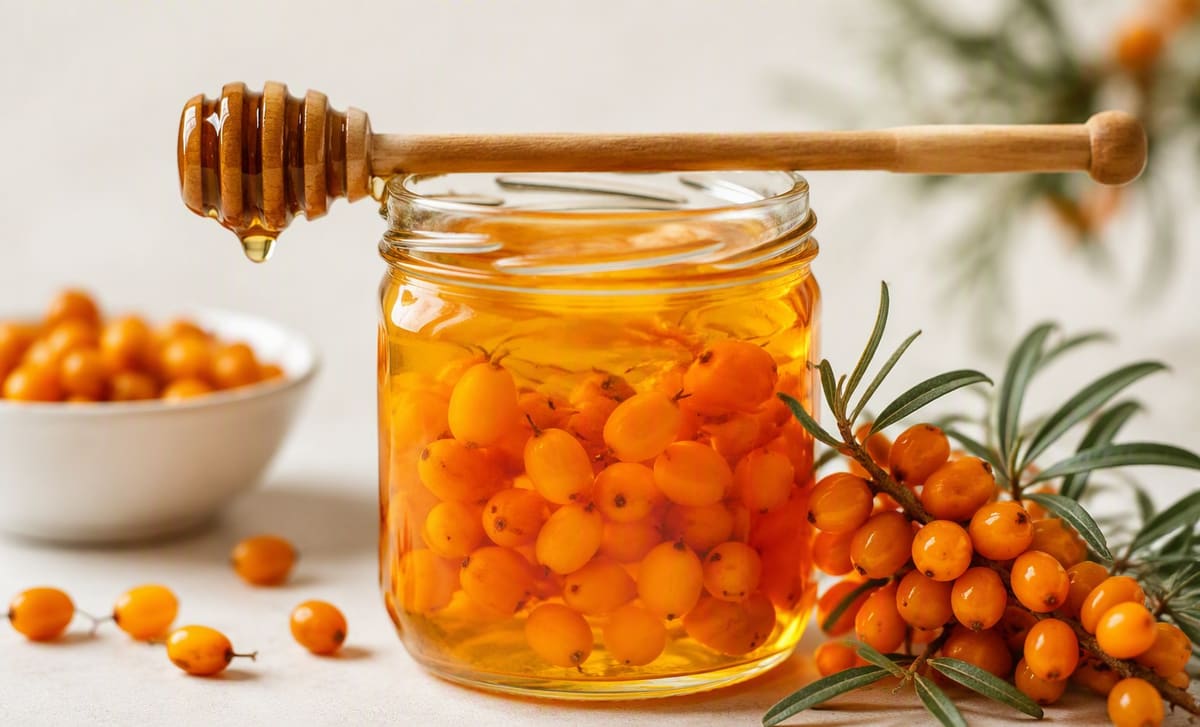
Sea buckthorn honey is honey infused with the berry, usually as juice, puree, or powder blended in. It is a genuinely pleasant spread with a tart edge, and it is honey first: the sea buckthorn content in a spoonful is small and nowhere near a studied amount of anything. Buy it for toast and tea, not for therapy.
What is actually in the jar
Two products wear this name. The common one is honey blended with sea buckthorn juice, puree, or powder: honey as the base, berry as the flavor. A rarer one is honey from bees that foraged sea buckthorn, which is a subtle, terroir product with no meaningful berry chemistry in it. The blended kind is what fills the shelves, and the label tells you which one you hold: the blended kind lists sea buckthorn in the ingredients.
Either way, the spoonful math is the honest test. The studied amounts of sea buckthorn in trials were grams of oil or a small handful of berries a day. A spoon of infused honey carries a fraction of a berry’s worth of the fruit. Delicious, yes. A dose, no.
Honey belongs with the jams and syrups on the food side of this plant’s catalog, not with the oils.
What it does keep
The berry’s flavor survives blending beautifully, and some of the water-soluble compounds come along for the ride: a share of the vitamin C if the honey was blended gently and kept cool, plus the tart acids. Honey itself is a decent preservative, so the jar keeps well. Store it like honey, cupboard and sealed, and expect some crystallization over time, which is normal and reversible in warm water.
The uses where it shines
- Tea: stirred into warm, not boiling, tea. High heat costs vitamin C, so let the cup cool a minute first. Our tea recipes build on exactly this pairing.
- Toast and yogurt: the everyday home, where the tartness cuts the sweetness in a way plain honey never does.
- Dressings and glazes: a spoonful in a vinaigrette or a glaze for roasted vegetables, where sour-sweet earns its place.
If the berry rather than the honey is the goal, the frozen berries deliver far more of it per spoon, and the jam page covers the cooked cousin of this jar. The forms comparison keeps the whole pantry in perspective.
Reading the jar
Three label lines matter. The honey base should be named: raw, wildflower, a specific origin. The sea buckthorn form inside should be named too, because juice, puree, and powder bring different things: juice brings the acids and some vitamin C, puree adds pulp solids, powder is the dried fruit milled in. A berry percentage, when stated at all, is the mark of an honest producer. And scan for glucose or fructose syrups in the ingredients, which is honey adulteration territory and has nothing to do with the berry.
The vitamin C arithmetic
Run the spoonful math once and the category explains itself. Fresh berries carry roughly 200 to 600 mg of vitamin C per 100 g. A 10 g spoon of honey blended at a generous 20% berry holds about 2 g of berries, worth roughly 4 to 12 mg of vitamin C at fresh-berry values, less if the blending saw heat. That is flavor-level, not dose-level, and it is why this jar lives in the pantry rather than the medicine cabinet. The vitamin C page has the fresh numbers, and the study dosages page shows what studied amounts actually look like.
The bee-foraged version, honestly graded
The rarer product is honey from bees that worked sea buckthorn flowers, sold as a terroir item in growing regions. It is a lovely idea with a chemistry footnote: nectar honey carries the flower’s sugars and aroma, not the berry’s nutrient payload, because berries are not what bees harvest. Buy it as a regional curiosity with a clean conscience, not as a shortcut to the fruit.
Storage, crystallization, and the microwave question
Cupboard and sealed is all honey asks. Crystallization is glucose doing what glucose does, normal and reversible in a warm water bath. Skip the microwave: hot spots cost the honey’s aromatics and what vitamin C the berry brought. Honey itself keeps for ages, but the berry fraction is the perishable part, so respect the jar’s date rather than honey’s immortal reputation.
Making your own
The homemade route is honest and easy: warm a jar of honey gently in a water bath, stir in sea buckthorn puree or powder to taste, and keep it in the fridge. You control the berry share, which no commercial jar states, and the batch is small enough to finish fresh. Frozen berries, crushed and strained, work beautifully as the source.
The souvenir-jar problem
Farm shops and tourist shelves in growing regions sell pretty jars of sea buckthorn honey, and the same label rules apply at the souvenir counter as anywhere else. A handsome jar with no ingredient list is decoration. A plain jar that names its honey, its berry form, and its origin is the one to pack.
Who this jar suits, and who should skip
It suits tea drinkers, toast people, cheese-board builders, cooks who like a sour-sweet glaze, and anyone buying a gift that will actually get used. The honey recipes and the salad dressing recipe are its natural homes. Skip it if the goal is a studied supplement effect, which the oil page covers in a different aisle. Price it like the grocery it is, using the same math as our price guide, and a pretty jar stops looking like a bargain quite quickly. Skip it for infants under one year, because honey is never for them, berry or not. And skip it if you count sugar, because honey is sugar, berry or not.
Frequently asked questions
Is sea buckthorn honey good for you?
It is honey with sea buckthorn stirred in, so the honest answer is: as good as honey, plus some of the berry's flavor and a share of its water-soluble compounds. The berry content in a spoonful is small, far from anything studied, so enjoy it as a nicer honey, not as a health product.
How do you use sea buckthorn honey?
Anywhere honey goes: stirred into warm (not boiling) tea, on toast, in yogurt, over porridge, or in salad dressings where its tart edge shines. Heat above a gentle warmth costs some of the berry's vitamin C, so add it at the table rather than to the pot.
Does sea buckthorn honey crystallize?
Yes, like nearly all real honey. Crystallization is glucose setting, not spoilage, and the berry content does not prevent it. Stand the jar in warm water and it reliquefies. Avoid the microwave, because hot spots cost both the honey's aromatics and what vitamin C the berry brought.