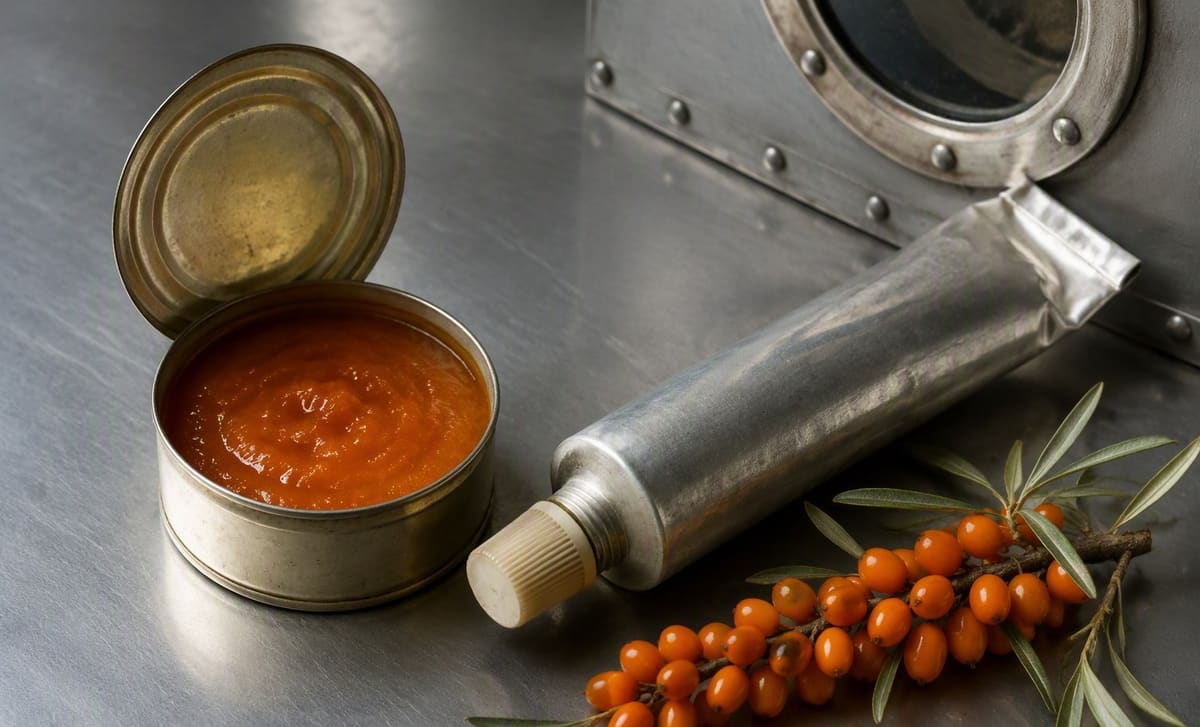
The Soviet space-program story is the most modern of sea buckthorn’s famous tales, and the hardest to grade cleanly. The documented core: Soviet institutions researched the berry seriously from mid-century, spanning nutrition, plant breeding, and skin-protection creams. The widely reported layer: cosmonaut supplies included sea buckthorn products. What we cannot do is name a mission, a menu, or a tube of cream from a primary source. So: institutional research, yes. Cosmonaut use, as commonly reported.
What is solidly documented
From the mid-twentieth century the USSR treated sea buckthorn as a serious subject. State research institutes studied its nutrition, Siberian and Altai breeding programs created orchard cultivars the world still plants, and Soviet laboratories produced oils and creams for skin protection. That institutional era is real, and the modern industry page shows what it built.
The cosmonaut story, as reported
The commonly repeated version: sea buckthorn preparations traveled with cosmonauts, as dietary support against the stresses of spaceflight and as creams for skin protection, including, in many tellings, protection from radiation exposure. The animal and laboratory studies behind that idea are graded on the radiation research page. This is plausible given the documented research culture, and it appears in many secondary sources. We simply could not verify it from mission records, so it stays in the reported tier, with no invented mission names or dates.
Olympic teams and other spinoffs
The same era’s sports-medicine culture generated its own stories, and claims that Soviet Olympic teams were dosed with the juice circulate in brand copy. Those sit one tier further down: unverified in any source we could check, much like the Genghis Khan legend, which borrows the same shape. China ran a parallel state program of its own, covered on the Chinese medicine page.
Why this era matters anyway
Strip the legend layer and the Soviet chapter still changed the plant’s fate: folk knowledge became agronomy and pharmacy. The cultivars, the processing methods, and much of the research mindset that Finland and China later extended started here, in the growing regions mapped on the Russia page. The history hub places this chapter in the longer arc.
The research culture behind the story
Mid-century Soviet science treated useful plants as state business. Institutes were tasked, breeding stations were funded, and results were published for a closed but serious research community. Sea buckthorn fit the culture perfectly: a native shrub, already gathered across Siberia, promising nutrition on difficult land. The Altai work in particular turned a wild thicket shrub into planted orchard rows, a pipeline the cultivation history page follows, and the world’s catalogs still sell the descendants.
What the creams were for
The skin-protection products are the believable core of the space story, because the berry oil’s skin resume is real and was studied. Modern trials later confirmed hydration and elasticity effects, with caveats, on the skin studies page, and the oil remains a skincare staple on the face oil page. A cream for cosmonauts sits comfortably inside that documented capability, which is exactly why the legend layer is so hard to peel off.
Grading the whole era honestly
The temptation with Soviet stories is binary: swallow the legend or trash it. The record supports neither. Institutional research, documented. Products for the space program, widely reported and plausible. Specific missions and menus, unverified. That three-tier read is the same one this site applies everywhere, and Russia’s modern industry, mapped on the Russia region page, runs on the same foundation.
The source test, applied
Ask of any cosmonaut claim what we ask of every story on this site: who recorded it, and where. Institutional research answers with institutes and publications. The spaceflight stories answer with other websites. Both answers are information, and only one kind is evidence. The distinction is the whole skill, and it transfers to every health claim you will ever meet.
Frequently asked questions
Did cosmonauts really take sea buckthorn into space?
Commonly reported, partially documented. Soviet institutions genuinely researched sea buckthorn from the mid-twentieth century, including nutrition and skin-protection products, and cosmonaut supplies are widely said to have included them. We could not verify specific missions or products from primary records, so we tell it as reported, not as proven.
What did Soviet sea buckthorn research actually produce?
Documented outputs: orchard cultivars from the Siberian and Altai breeding programs, nutritional studies, and sea buckthorn oils and creams made for skin protection. That institutional record is solid. The spaceflight layer, specific menus and missions, is widely reported and remains unverified at primary-source level.