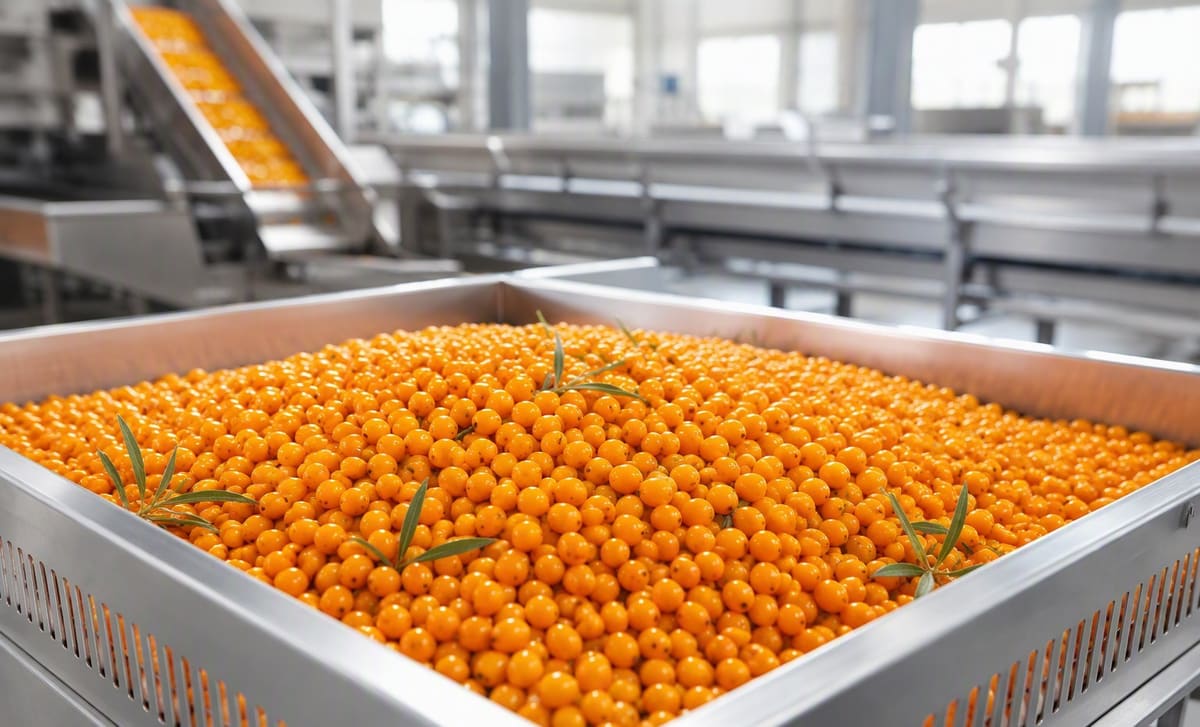
The modern sea buckthorn industry is about forty years old, and it was built by governments before brands. China’s 1980s erosion-control program planted the raw material at massive scale, Soviet and Russian breeding supplied the cultivars, Northern Europe added research and quality standards, and Canadian prairie programs proved the crop in North America. Today’s supplement shelves sit on that scaffolding.
China’s million-hectare foundation
In the 1980s China designated sea buckthorn for land rehabilitation and planted it across eroded country, the Loess Plateau most famously, on a scale reaching millions of hectares. The shrub was chosen for barren-ground toughness and self-fed nitrogen, and the berries became a paying rural industry on top of the erosion control. That single decision is why most of the world’s raw fruit is Asian today, a story told at farm scale on the cultivation history page and mapped on the China region page. The history hub keeps the long story in order.
The breeding pipeline
Soviet programs in Siberia and the Altai created the first true orchard cultivars: larger berries, heavier crops, fewer thorns. Russian breeding continued that line, and German and Finnish programs adapted cultivars and quality standards for northern Europe. The Soviet research culture behind it all, space-age legend layer and documented core alike, is sorted on the cosmonauts page, and the radioprotection studies it inspired are weighed on the radiation research page.
Canada’s prairie chapter
Canadian researchers tested the shrub for prairie conditions in the late twentieth century, and Canadian-bred cultivars followed. The sector there stayed small and quality-focused, proof that the crop works in North American winters rather than a volume play.
The market today
Put the chapters together and the supply chain makes sense: raw berries mostly from Asia, cultivar genetics mostly Soviet-descended, premium processing and research led by northern Europe, and a global shelf of juice, oils, softgels, and skincare built on top. The medical tradition that started the whole arc lives on the Tibetan medicine page and the Chinese medicine page.
The processing revolution
Raw berries are not an industry. They are too soft to ship and too sour to sell. The industry exists because pressing, freezing, drying, and oil extraction turned a fragile harvest into stable goods: juice and concentrate, frozen berries, powders, and the two oils. The forms compared page shows what each form keeps from the berry.
The research economy
The modern industry runs on studies as much as on orchards. Finnish labs produced the landmark dry-eye and skin trials, and Chinese institutions now publish much of the volume. Two meta-analyses on blood lipids anchor the strongest claim the industry has, summarized on the cholesterol meta-analysis page. The honest summary lives on the clinical trials page: some claims earned their shelf space, and others rode along.
What stayed small
Not everything scaled. Leaf tea, seed press cake, and the cosmetic side streams remain niche beside the oil and juice core, and wild gathering still supplies a share of premium fruit. The industry’s center of gravity never moved far from the berry’s two old strengths: a drinkable sour fruit and an unusual oil.
Reading today’s shelf with the history in mind
Forty years of state programs and breeding produced a strange market: world-class raw material, uneven product quality, and marketing that quotes the legends more readily than the trials. Origin stories mean less than disclosure, which is why our oil guide scores labels on what they say, not where they say it from.
The forty-year verdict
Judged as an industry, the modern era delivered: raw supply at scale, cultivars worth planting, processing that works, and a research base with real trials in it. Judged as marketing, it over-reached, quoting legend where it could have quoted data. The gap between those two verdicts is exactly what the buying guides on this site are for.
Frequently asked questions
Where is sea buckthorn grown commercially today?
China dominates raw production, the result of a 1980s state program that planted the shrub for erosion control on millions of hectares. Russia and Eastern Europe grow Soviet-bred cultivars, Germany and Finland run smaller quality-focused sectors, and Canada has a prairie orchard industry. Most berries in supplements trace back to Asian wild or cultivated stock.
Why did sea buckthorn take so long to industrialize?
The plant resisted. Thorns slow every picker, ripe berries burst in the hand, and wild stock varies from bush to bush. Industrial supply waited on bred cultivars, clonal planting stock, and mechanical harvest methods, most of which arrived only in the late twentieth century. The bottleneck was agriculture, not demand.