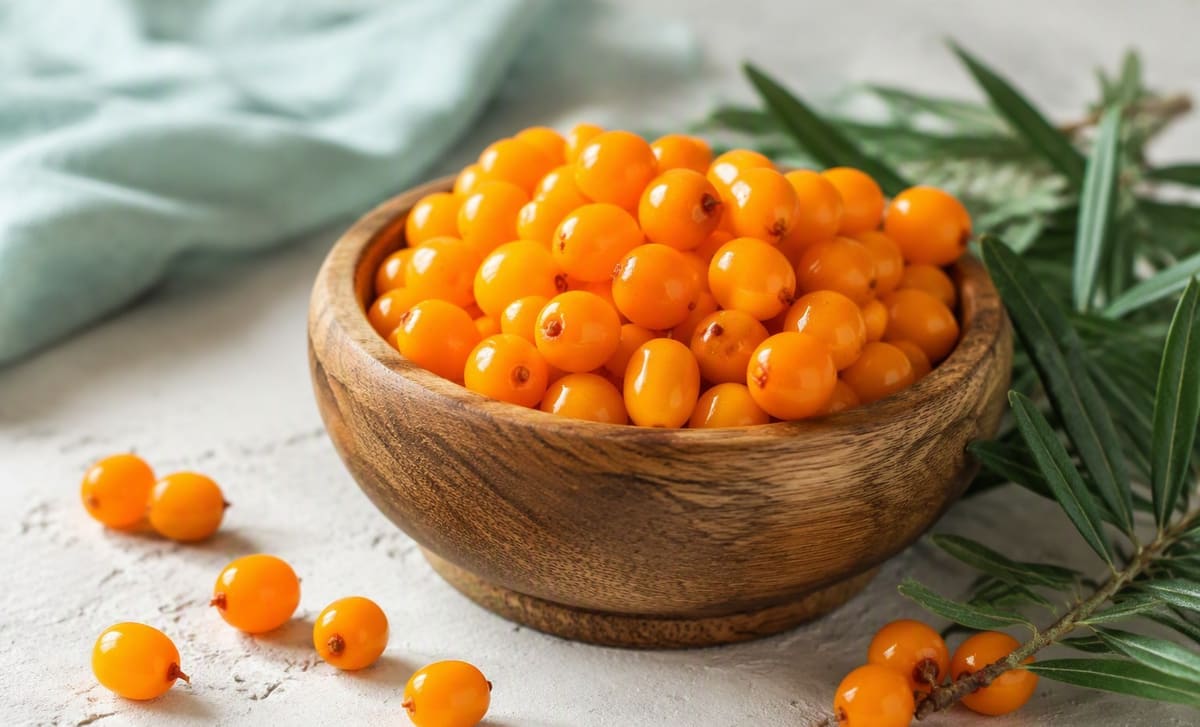
Yes, you can eat sea buckthorn berries raw, and as food they are safe for basically everyone. The catch is sensory, not safety: they are among the most sour berries you will ever taste. Freeze them to take the edge off, start with a small handful, and keep them away from white clothing, because the juice stains on contact.
The honest taste report
Bite one and the first thing you get is acid: malic and quinic acids, the same family that makes rhubarb and sour apples pucker, turned up well past either. Underneath the sourness sits a tropical, slightly musky aroma that people compare to passionfruit. The second berry is easier than the first, and by the fifth you understand why every traditional cuisine that uses them adds sweetness, fat, or dilution. The how-to-use hub lays out those gentler ways in.
The freezing trick
Freezing mellows them noticeably. A night in the freezer softens the texture and rounds off the sharpest acidity, and frozen berries hold their shape for smoothies, yogurt, and baking. If you buy or pick more than a handful, freezing is also how you keep them, since fresh berries are delicate and perish fast.
Where to find fresh berries
Fresh sea buckthorn rarely appears in supermarkets because the berries are soft and stain everything. Your realistic options: farmers markets in regions where it grows, pick-your-own farms, or growing your own, which our growing guide covers from plant to harvest. Frozen berries from specialty suppliers are the year-round substitute.
Picking notes
Two warnings from everyone who has done it. First, the thorns are real, numerous, and unfriendly, so gloves are not optional. Second, the berries burst easily and the juice stains skin, clothing, and countertops a bright orange that outlasts most apologies. Old clothes, gloves, and a shallow container beat enthusiasm every time.
How much is sensible
A small handful as a food, the way you would eat any intensely sour berry. The one whole-berry trial dosed 28 grams a day for three months with good tolerability, which is a small handful’s worth. If the sourness wins, the recipes hub has better delivery systems, from juice to jam, and the vitamin C page explains what those berries bring to the bowl.
The first-taste protocol
Eat one berry, not a handful. Wait a minute. The acid hits in the first seconds and the tropical aroma arrives after it, and people who like the second act tend to like the fruit. Three to five berries is a sensible first sitting. If you reach for more, the fruit agrees with you. If you reach for water, the frozen and sweetened routes below are yours.
What a small handful actually is
The whole-berry trial dosed 28 grams a day for three months, which is roughly 30 to 40 berries, a small handful or a quarter cup. At the fresh-fruit vitamin C range of 200 to 600 mg per 100 grams, that handful delivers roughly 60 to 170 mg of vitamin C, comparable to a whole orange, along with fiber and the berry’s oils. That is a real nutritional contribution from a genuinely small serving.
Three ways to make raw workable
- Frozen, straight from the freezer. Texture softens, acidity rounds off, and the berries eat like tiny sorbet pellets.
- Cut with fat or sweetness. A handful over yogurt with honey, or alongside cheese, is the traditional answer in every cuisine that grows them.
- Mixed, not solo. Into muesli, over a smoothie bowl, or baked into muffins where their sourness reads as a feature. The make juice page is the route when eating them is simply not happening.
Who should go gently
The berries are food, safe for children and pregnant women in normal amounts. The acidity is the only real variable: anyone with reflux, gastritis, or an ulcer should treat a bowl of raw berries like a glass of straight juice, per the acid reflux page, and keep portions small and with meals. Teeth appreciate the same rules as juice: rinse with water after, brush later.
When the season runs
Fresh berries appear from late summer into autumn, briefly, and the frozen berries explainer covers the year-round substitute that loses almost nothing. Getting hold of either is its own problem, and our where to buy guide covers which sellers ship fruit rather than only bottles. Outside that window, anyone selling you fresh is selling you thawed. Fresh berries keep two to three days in the fridge at most, spread on a tray so their own weight does not crush the bottom layer. The freezer is where the harvest actually lives.
The stain protocol
Berry juice on skin fades in a day and washes off faster with oil than with soap. On fabric, treat it immediately with cold water and accept that pale cotton may keep a souvenir. Countertops wipe clean with a little cooking oil on a cloth. The picking uniform is old clothes, and every experienced picker has one. Consider it the tax on the most interesting berry in the freezer.
Frequently asked questions
Are raw sea buckthorn berries safe to eat?
Yes, as a food. The berries themselves are fine for anyone, including pregnant women, because the safety cautions on this site concern concentrated oil supplements, not the fruit. The one practical caution is the acidity: a small handful is pleasant, a large bowl on an empty stomach is asking for trouble.
What do raw sea buckthorn berries taste like?
Intensely sour with a tropical, almost passionfruit-like aroma underneath. The sourness comes from malic and quinic acids, and it is strong enough that most people prefer the berries frozen, sweetened, or mixed into something. Nobody describes their first raw berry calmly.