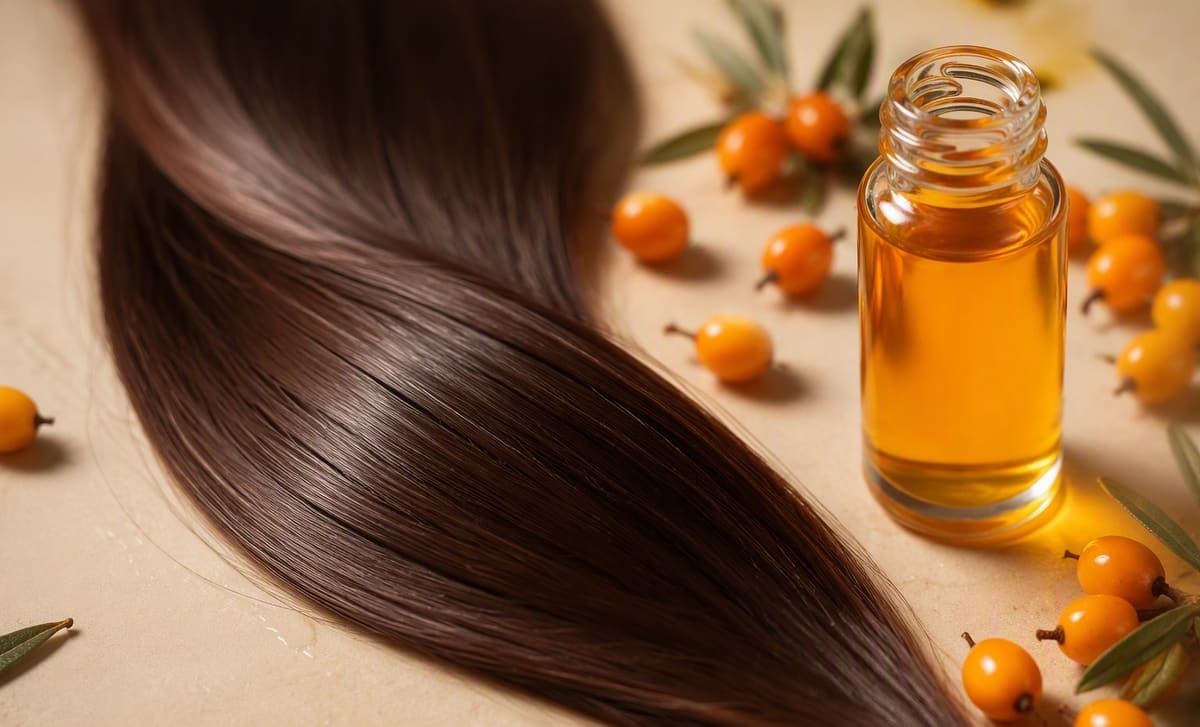
No human trial has ever tested sea buckthorn for hair growth. Everything claimed for it rests on tradition and on nutrients that exist in the oil and also matter in follicle biology. That makes “supports a healthy scalp” defensible and “regrows hair” invented. If growth is the goal, proven options exist, and this oil can only play support.
The argument for, stated fairly
Hair follicles are skin, and sea buckthorn oil has real evidence for skin hydration and elasticity. It carries vitamin E, carotenoids, and fatty acids that appear in legitimate hair-biology research. A well-moisturized, uninflamed scalp is a better environment for hair than a dry, flaky one.
Every word of that is true. None of it demonstrates regrowth. Skin evidence does not transfer automatically to follicles, and nutrient presence in a bottle says nothing about reaching a follicle at a useful dose.
The argument against, stated plainly
- No human hair trials. Zero.
- The animal and cell studies behind online claims used doses and routes that do not translate to a scalp massage.
- Hair loss has real causes (hormones, genetics, thyroid, iron, stress) that an oil cannot touch.
What is shown versus what is marketed
Here is every hair claim you will meet on a bottle or a product page, beside what actually stands behind it. Four of the seven rows land at the bottom grade for the same reason: nothing has been measured.
| Claim you will see | What the evidence is | Grade |
|---|---|---|
| “Regrows hair” | No human trial has tested sea buckthorn for hair count, thickness, or shedding. There is nothing to grade | ●○○○ No clinical trials |
| “Stops hair loss” | The same blank, and the usual causes of loss, meaning hormones, genetics, thyroid, and iron, are not things an oil reaches | ●○○○ No clinical trials |
| “Clinically proven for hair” | There is no clinical trial for it to be proven by. Read the phrase as a flag on the seller, not a finding | ●○○○ No clinical trials |
| “Backed by studies” | The studies behind these claims are cell cultures and lab animals, at doses and routes that do not resemble a scalp massage. No human study followed | ●●○○ Preliminary, and preliminary about the source material rather than about hair |
| “Rich in vitamin E, omega fatty acids, and carotenoids” | True as composition, and verified in fatty acid profiles of the oil. A nutrient in a bottle is not a dose arriving at a follicle | ●○○○ for any hair outcome |
| “Supports a healthy scalp” | The nearest real data is oral oil improving skin hydration and elasticity, measured on facial skin in the skin trials. Scalp was never an endpoint | ●●○○ Preliminary, borrowed from skin |
| “Adds shine, smooths ends” | A cosmetic effect you can see within weeks, and the one honest reason to own the bottle | ●○○○ Traditional use, grooming rather than growth |
The grades are not a slow build to a positive verdict. They stop where the research stops, and on this topic the research never started.
The sane way to use it
If you enjoy the oil, use it as a pre-shampoo scalp treatment or a few drops on damp ends for shine, with seed oil on the scalp as the lighter option. Our hair hub has the routine, the seed vs berry page explains the oil choice, and if you want a bottle worth the shelf space, see which ones we rank for conditioning. Just budget it as conditioning, not treatment.
What actually regrows hair
Minoxidil and finasteride have decades of trial data. Sudden shedding, patchy loss, or loss with fatigue or weight change deserves a doctor and basic blood work first, because fixable causes hide there. Sea buckthorn can share a shelf with those answers. It cannot replace them.
The nutrient logic, itemized
The honest case starts with real contents. The oil carries vitamin E, carotenoids, and a fatty acid spread that includes omega-7 in the berry oil and omega-3 with omega-6 in the seed oil. Every one of those appears in legitimate skin and follicle biology. The follicle is a skin structure, so the reasoning goes, feeding the skin feeds the hair. The reasoning is coherent. It is also where the evidence stops. The berry oil’s omega-7 gets the marketing, but marketing is not an endpoint.
Why presence is not a dose
A nutrient in a bottle and a nutrient reaching a follicle at a useful concentration are different events separated by absorption, transport, and dilution. Topical oil sits mostly on the surface it is spread on, which is the scalp’s outer layers, not the follicle base where hair is made. Oral oil feeds the whole body a few grams at a time, and no measured route has ever been tied to a hair outcome in a human trial.
Why animal and cell studies do not settle it
The studies behind online growth claims used cell cultures and lab animals, at doses and by routes that do not resemble a scalp massage. Cells in a dish meet the extract directly. Mice receive scaled doses no sensible human routine matches. That is how preliminary science works, and it is why our evidence file lists no human hair entry at all. The how to read studies page walks through this exact gap, and the study dosages page shows what human doses actually look like where trials exist.
The stress and shedding chapter
One real cause deserves its own paragraph: a shock to the system can push hair into a shedding phase weeks later, after illness, surgery, major stress, or rapid weight change. That pattern usually reverses on its own over months, and an oil neither causes nor cures it. What matters is recognizing it, because shedding that arrives with fatigue, weight change, or feeling cold points at thyroid or iron, and that is blood-work territory.
The proven options, one level deeper
Minoxidil and finasteride remain the two treatments with decades of human trial data for pattern loss. Both take months to show results, both work better at keeping hair than regrowing it, and both carry suitability questions that make them doctor conversations rather than recommendations from us. The consistent finding across that literature is that earlier starts keep more hair, which is why waiting a year on oils has a real cost.
If you use it anyway
Then use it well: seed oil on the scalp before washing, a drop on damp ends after, and honest expectations filed under grooming. The routine feels good, the shine is real, and the price of pretending it is a treatment is measured in months you could have spent on options with trials.
The honest bottom line
Sea buckthorn is a conditioning oil with a plausible nutrient story and no human hair trial. Used as grooming, it earns its place. Sold as a growth treatment, it fails a test it never took. The distinction is this whole page in two sentences.
Frequently asked questions
Can sea buckthorn regrow hair?
There is no human evidence that sea buckthorn regrows hair. No clinical trial has tested it for hair count, thickness, or shedding. Its nutrients (omega fatty acids, vitamin E, carotenoids) play roles in skin and follicle biology, which is suggestive but not proof. For actual regrowth, minoxidil and finasteride have the trial data.
How long should I try sea buckthorn before judging hair results?
For conditioning, judge after four to six weeks of the pre-wash ritual. For growth, there is no trial-defined timeline because there are no trials. If shedding is your concern, do not spend months waiting on an oil: sudden loss, patches, or loss with fatigue or weight change deserves a doctor and basic blood work first.