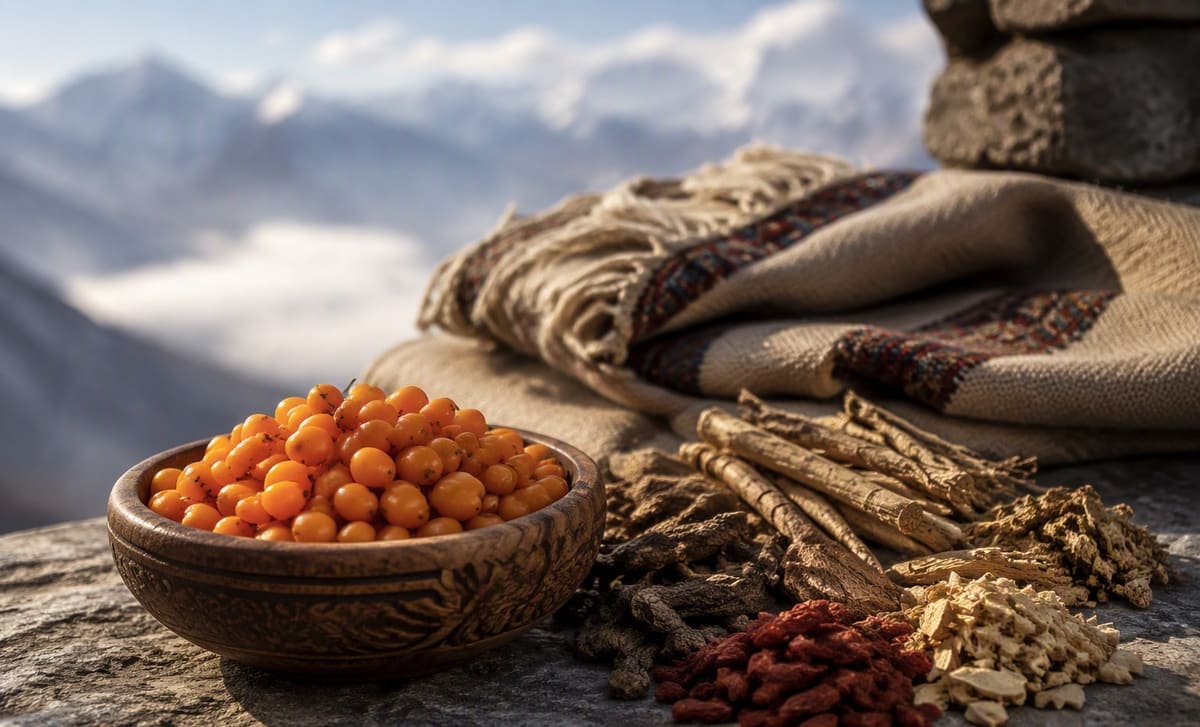
The deepest documented use of sea buckthorn anywhere is Tibetan. Classical Tibetan medical texts, in the rGyud bzhi (Four Tantras) tradition, discuss the berry under the name star bu, for digestion, coughs, and skin complaints. That written record runs roughly a thousand years, and it is the anchor of every traditional-use claim this plant has.
What the texts actually record
In the classical Tibetan system, star bu appears as an ingredient in multi-herb formulas rather than a standalone cure. The recorded uses cluster around digestion, coughs and other lung complaints, and skin problems. Tibetan medicine is a living tradition, not a museum piece, and practitioners still prescribe sea buckthorn preparations today.
Why this record is different from the legends
Three things separate it from the horse-and-warrior stories. The sources are dated texts, not word of mouth. The tradition names the plant and its preparations specifically. And the practice continued without interruption into the present. That is documentation, and it is why the Genghis Khan story looks so thin by comparison: the legend borrows credibility that this record actually earned.
How the knowledge traveled
Tibetan medical learning did not stay on the plateau. It shaped Mongolian medicine directly, and it fed into Chinese medical literature through centuries of exchange, a path the Chinese medicine page traces. The growing world behind the medicine, the Himalayan belt where the berries were gathered, is mapped in the India region page, and the neighboring traditions meet on the Ayurveda page.
What tradition can and cannot tell us
A thousand years of continuous use says something real about basic safety at food-level doses, and about what generations of doctors thought worth treating. It cannot prove the treatments worked by modern standards. That is the trial question, and traditional use versus evidence lays out how we grade it. The history hub sets this record beside the other chapters.
The formula logic
Classical Tibetan remedies are recipes, not single herbs. Star bu appears as one ingredient among several, combined to balance what the tradition describes as the body’s principles. That context matters for honest reading: the texts never promised what a lone berry could do, they described what a prepared formula was for. Modern single-ingredient capsules are a different idea entirely, and the tradition would not recognize the marketing written around them.
The gathering calendar
The medical record ran on a wild harvest. Berries came from riverside and valley thickets in autumn, gathered by hand from thorny wood, a harvest the berry page describes from the plant side. Leaves had their own preparation niches. Nothing about the supply was industrial, and the terrain the gatherers worked is the same ground the India Himalayan region page maps today.
What modern research confirmed and corrected
The modern trial record lands near the old targets, with honest distance. Skin use has human trials behind it now, summarized on the skin studies page, and the dry-eye trial on the dry eye research page echoes the old eye complaints. Digestion claims remain mostly untested by modern standards. Tradition pointed, trials measured, and the overlap is real and partial, exactly as traditional use versus evidence frames it.
The tradition today
Tibetan medicine still practices, in the Himalayan belt and in exile communities, and sea buckthorn still appears in its pharmacy. The gathering and the prescribing continue side by side in the same valleys, which makes this record unusual among the plant’s chapters: not a finished history but a continuous one.
Reading the texts with care
The classical texts are medical literature of their era, written inside the framework of their own system. Reading them as modern pharmacology misses what they are, and reading them as poetry misses what they do. The honest read sits between: a serious record of observed use, preserved well enough to question, and answerable only by modern methods.
Frequently asked questions
What is sea buckthorn called in Tibetan medicine?
Star bu. Classical Tibetan medical texts, in the rGyud bzhi (Four Tantras) tradition, record it for digestion, coughs, and skin complaints, usually within multi-ingredient formulas. That written record, roughly a thousand years deep, is the strongest documented traditional use the plant has anywhere.
Is sea buckthorn still used in Tibetan medicine today?
Yes. Tibetan medicine is a living tradition, and practitioners in the Himalayan belt and in exile communities still prescribe sea buckthorn preparations, usually inside multi-ingredient formulas, for the same families of complaints the classical texts record: digestion, coughs, and skin.