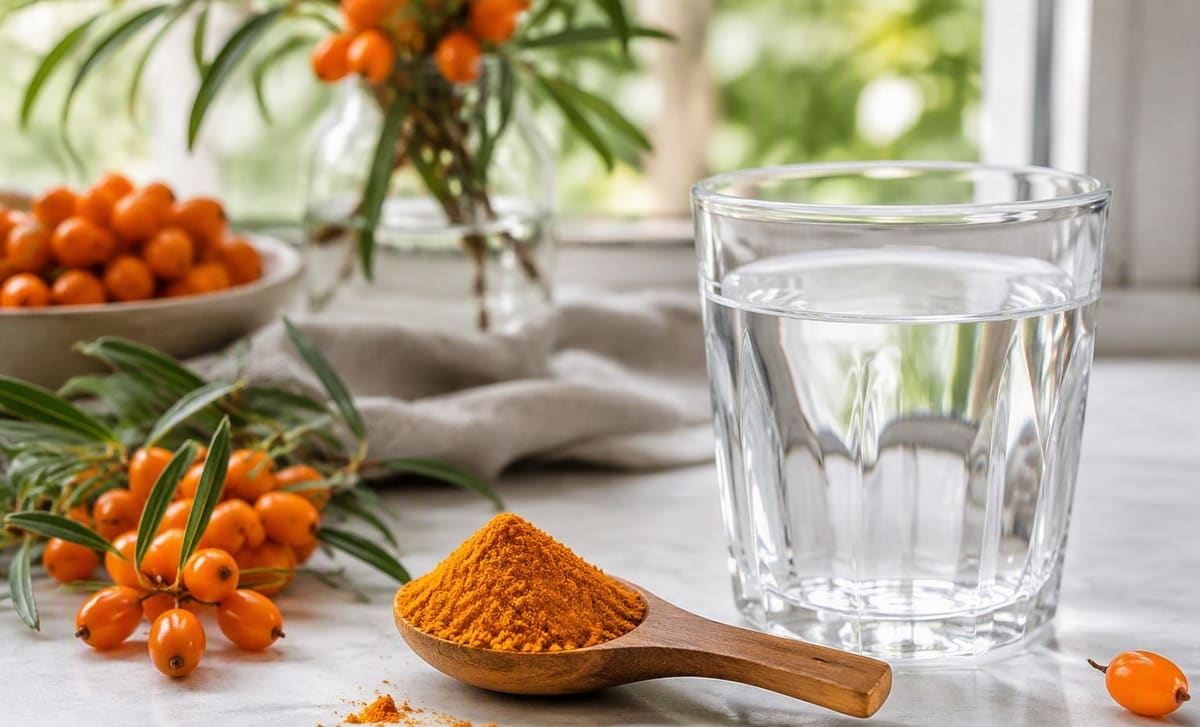
Sea buckthorn powder earns its shelf space as a daily food habit: one to two teaspoons stirred into something you already eat. Smoothies, yogurt, oatmeal, baking, and a quick steeped drink all work. What it will not do is replace the oil doses from the studies, so keep it in the food category where it belongs.
The five uses that stick
- The smoothie spoon. One to two teaspoons into any smoothie. The tartness flatters banana, mango, and orange.
- The yogurt swirl. Stirred into plain yogurt with a little honey. The fat and sweetness soften the acid edge, and the color is spectacular.
- The oatmeal stir. Added after cooking, off the heat. Same logic as yogurt, warmer.
- The baking fold-in. Folded into muffin or energy-ball batter for color and tang. Heat costs some vitamin C, so bake for flavor, not for nutrition math.
- The quick steep. A teaspoon in hot (not boiling) water with honey, as a fast sour-orange drink.
Dose realism
One to two teaspoons a day is the typical pattern, and there is no studied therapeutic dose for powder. The human trials dosed 1 to 3 grams of oil, and a spoonful of powder carries a small fraction of a gram of oil. Powder is food: fiber, tart acids, some vitamin C, bright color. For the studied benefits, the dosage page maps the oil doses, and the how-to-use hub sets powder beside the forms that carry one. For everything powder-specific, the powder explainer covers what drying keeps and loses, and the recipes hub has more ways to use it. Fillers are the thing to avoid in a jar you eat by the teaspoon, and our verified powder pick is the single-ingredient one.
The teaspoon, defined
A level teaspoon of sea buckthorn powder weighs about 2 to 3 grams, and that spoon is the serving every use below assumes. What it carries: fiber, the tart organic acids, a share of the fresh berry’s vitamin C, and a trace of the berry’s oil, a few percent by weight. What it does not carry: anything close to the 2 to 3 grams of oil the trials dosed. The powder is a food with a bright resume, and the resume stops there.
The clump problem
Powder pulls moisture from the air and sets like concrete when it wins. Three habits prevent it: a dry spoon every single time, the jar opened for seconds rather than minutes, and immediate stirring when it hits liquid. In smoothies, add it to the blender with the other dry ingredients rather than dusting it over the top. In baking, sift it with the flour. Clumps in the jar mean the lid lost, and a sift fixes most of the damage.
Three more uses
- Chia pudding. A teaspoon whisked in with the chia, where the overnight soak dissolves it completely and the color goes sunrise.
- Energy balls. Two tablespoons per batch of date-and-nut balls, where the sourness balances the dates perfectly.
- A rub for rich fish. Mixed with salt and a little sugar and pressed onto salmon before roasting, where it behaves like a citrus zest with ambitions.
Powder versus the supplement forms
Readers sometimes land here hoping powder is the cheap route to the studied oil doses. It is not, and the math is unkind: at a few percent oil by weight, matching 2 grams of oil would mean eating most of a jar a day. Capsules and liquid oil carry the studied doses. Powder carries the kitchen. Both earn their place, and confusing them disappoints both.
Mistakes that waste the jar
- Cooking it for nutrition. Heat and time cost vitamin C, so stir it in after cooking when nutrition is the point. Bake with it for flavor and color instead.
- The heroic spoonful. Doubling the dose doubles the sour, not the benefit. One to two teaspoons is the pattern that survives past week one.
- Leaving the jar open for convenience. Moisture is patient and the powder is thirsty. Seal it.
- Judging it like a supplement. Food-level inputs give food-level returns, and that is a fine deal, per the fiber page.
What to expect, honestly
A daily spoon in yogurt or a smoothie adds tang, color, fiber, and a little vitamin C to food you were eating anyway. That is the entire promise, and it is enough to justify the shelf space. Powder suits the cook, the smoothie person, and anyone who wants the berry in their food rather than their medicine cabinet. The yogurt bowl recipe is the easiest daily vehicle, and the dried berries page covers the chewier whole-fruit alternative for the same job.
The color bonus, used deliberately
Powder’s orange is strong enough to work as natural food coloring: a pinch turns frosting, white chocolate, or pancake batter sunrise without a drop of dye. Bakers pay good money for that trick, and this jar does it as a side effect of breakfast. Start with a pinch and build, because the color arrives before the taste does.
Frequently asked questions
How much sea buckthorn powder should I use a day?
One to two teaspoons is the typical food-level serving, and no studied therapeutic dose exists for powder. It is a whole-food ingredient, not a supplement substitute. More powder mostly means more sour, so let taste set the amount.
Does sea buckthorn powder have side effects?
At food-level servings, rarely. A spoon or two a day is well tolerated, and the main complaint is the sourness itself. Large amounts on an empty stomach can grumble digestion thanks to the acids, so take it with food. Supplement-strength cautions concern concentrated oil, not kitchen powder.