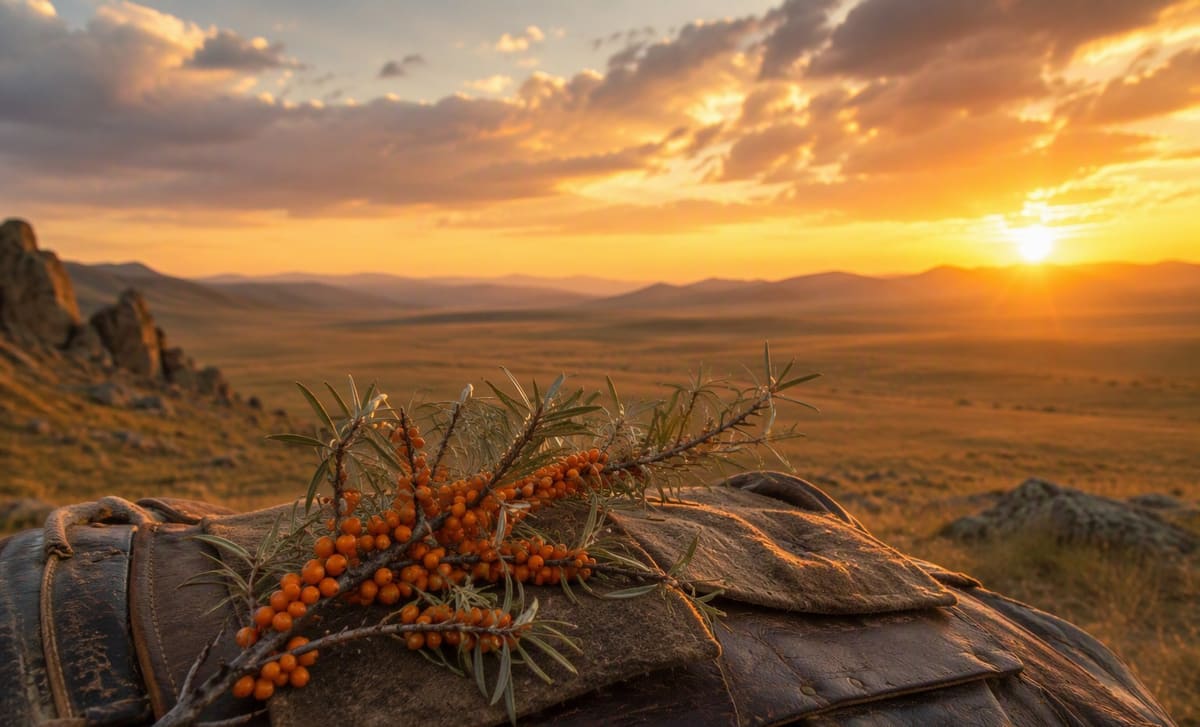
The Genghis Khan sea buckthorn story, armies and war horses powered by the berry, is all over supplement sites and in no primary source we can find. File it as legend. The true Mongol-era story is more ordinary and more interesting: Tibetan and Mongolian medicine used the berry for centuries, and the empire helped move that knowledge around.
What the legend claims
Brand copy usually runs like this: Genghis Khan’s soldiers ate sea buckthorn for strength and stamina, his horses grew glossy coats and recovered faster on it, and the berry helped power the conquest of half the known world. Some versions add that his armies planted it along the march routes. The history hub keeps the tiers separate on purpose, and this one is legend.
Why it fails the source test
Nothing in the Secret History of the Mongols, or in the Persian and Chinese chronicles of the era, names this plant. The story circulates in modern marketing, and every citation we chased pointed at another brand page rather than a chronicle. Mongol armies did run on remarkable logistics: dried meat, fermented mare’s milk, and relay horses. None of that needed a berry.
The real Mongol connection
What is documented: Mongolian traditional medicine used sea buckthorn for centuries, for digestion, coughs, and skin, in close partnership with Tibetan medicine. The empire’s reach moved that medical knowledge between Tibet, China, and Central Asia, a flow the Chinese medicine page picks up. That is the honest version of the conqueror’s berry: not a war ration but a shared medicine chest, still used across Mongolia today.
How to read legends like this
The recipe is always the same: a grain of truth, here a real traditional use, plus a famous name, plus a leap to a modern product claim. The Greek horse story on the Greek origins page fails the same test, and traditional use versus evidence shows how we grade the gap.
What a war ration looked like
The documented Mongol campaign diet ran on dried meat, fermented mare’s milk, and a relay system of horses: food that kept for months and traveled at speed. A soft berry that bursts in the hand and fruits for a few weeks a year fails every requirement of that logistics chain. The legend asks the plant to do a job the army never needed done, in a form the plant could never have supplied.
Why the story attached to him
Famous names are magnets, and the conqueror’s name is the strongest magnet Central Asia has. Attaching a product to his army borrows the era’s aura of endurance and victory. The tell is always the same: the claim grows more detailed as it moves further from any source, gaining march routes and planting programs that no chronicle mentions.
The berry the steppe actually knew
Wild sea buckthorn did grow across the empire’s territory, along rivers and in mountain valleys, and steppe peoples gathered and used it within their medical tradition, as the Tibetan medicine page documents for the wider region. The honest image is quieter: herding families picking riverside berries in autumn, not an army marching on them. The foraging guide describes the same harvest today, minus the empire.
What modern research would say to a warrior
The nutrient profile genuinely suits hard physical labor: dense vitamin C, unusual oils, calories in a small package. But the clinical record is built on civilians, and the benefits with trial support, lipids and dry eyes and skin, are peacetime concerns, graded on the benefits hub. Even the best modern reading of the berry does not turn it into a war ration.
Frequently asked questions
Did Genghis Khan really use sea buckthorn?
No evidence says so. The story appears in modern supplement marketing, not in any chronicle of his era. What is real: Mongolian traditional medicine used the berry for centuries, and that tradition is documented in later medical texts. The legend borrows that real history and straps it to a famous name.
What did Mongol armies actually eat?
The documented campaign diet ran on dried meat, fermented mare's milk, and a relay system of horses: food that kept for months and moved at speed. No chronicle of the era names sea buckthorn or any berry as a ration. The army's logistics were remarkable enough without decoration.