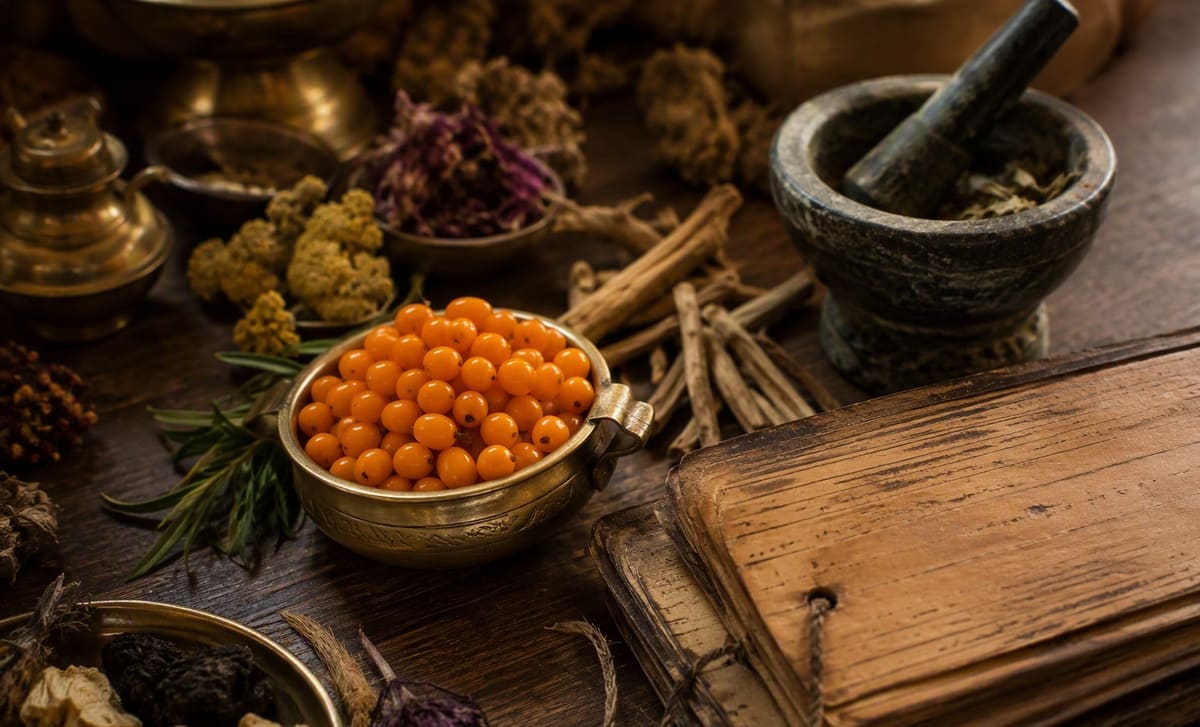
Honest answer first: sea buckthorn is not a classical Ayurvedic plant. The great Ayurvedic texts were written far from its mountain home and center on other berries, amla above all. Sea buckthorn belongs to the folk traditions of the Himalayan belt, where Ayurvedic, Tibetan, and local practice overlap. Marketing that calls it an ancient Ayurvedic superfruit is borrowing someone else’s credentials.
What the classical texts do not say
The classical anchors of Ayurveda, the Charaka and Sushruta traditions, do not feature sea buckthorn. The celebrated sour berry of those texts is amla, the Indian gooseberry, a different plant with its own deep record. No honest reading of the classical literature turns sea buckthorn into a rasayana, and we will not manufacture a Sanskrit name to pretend otherwise.
Where the plant actually fits
In the Himalayan belt, across Ladakh, Himachal, and Nepal, people have eaten and used these berries for generations, in a zone where Ayurvedic practice meets Tibetan medicine and older folk custom. That use is real, regional, and late to be written down: plausible tradition rather than classical documentation. The same mountain routes carried the berry’s use toward China, a flow the Chinese medicine page documents. The India region page describes the belt where it happens.
The amla confusion, and why it matters
The mix-up is convenient for sellers. Both berries are famously sour and vitamin C rich, so sliding amla’s classical prestige onto sea buckthorn makes ordinary products sound ancient. It misleads buyers about both plants. The honest summary: sea buckthorn is a Himalayan food and medicine adopted into regional practice, and its documented home is the Tibetan record, not the Ayurvedic one. For how we grade tradition against trials, see traditional use versus evidence. The Greek origins page shows another story that needed the same honesty, and the history hub keeps the tiers straight.
What the Himalayan use looks like
The regional record is practical: berries eaten fresh and dried, juice and preserves at harvest, oil for skin and minor wounds, stores laid by for winter. This is food-and-remedy use, the pattern of every mountain community living beside a useful shrub. It was rarely written down because it never needed to be, and that quiet record deserves respect without inflation.
How the confusion pays
Amla carries classical prestige, and sellers borrow it. The plants are unrelated: amla is a tree fruit of the lowlands, sea buckthorn a shrub berry of the high cold country, and their chemistry differs as much as their botany. The amla comparison page puts the two side by side, and the vitamin C page grades the one claim they share. Buyers deserve the same honesty on both sides: amla’s record is real, and so is sea buckthorn’s, and each loses something when the other borrows it.
What modern research added
The trial record for sea buckthorn was built far from the classical texts, mostly in Finland and China, and it stands on its own. Skin and lipid results are its strongest chapters, summarized on the skin studies page and the cholesterol meta-analysis page. None of that validation travels backward into Ayurvedic status. A plant can be honestly useful and honestly outside a tradition at the same time, and the benefits hub keeps the confirmed list current.
The boundary on the map
Geography explains the boundary better than any text. Classical Ayurveda grew in the lowland plains and river valleys, and sea buckthorn lives in the high cold country where that world thins out. A plant outside the physicians’ daily world stays outside the classical canon. Where the altitude drops and the traditions meet, the berry enters practice, and the written record thins to match.
Frequently asked questions
Is sea buckthorn used in Ayurveda?
Not in the classical texts. Ayurveda's famous sour berry is amla, a different plant, and sea buckthorn never held that status. In the Himalayan belt where Ayurveda meets Tibetan and folk medicine, the berries are used regionally for food and remedies, and that tradition is real. The ancient Ayurvedic superfruit line is marketing, not history.
Is sea buckthorn the same as amla?
No. Amla is the Indian gooseberry, a tree fruit with its own classical Ayurvedic record, and sea buckthorn is a Himalayan shrub berry from a different plant family. Both are sour and vitamin C rich, which is exactly why marketing blurs them. The amla comparison page separates the two.