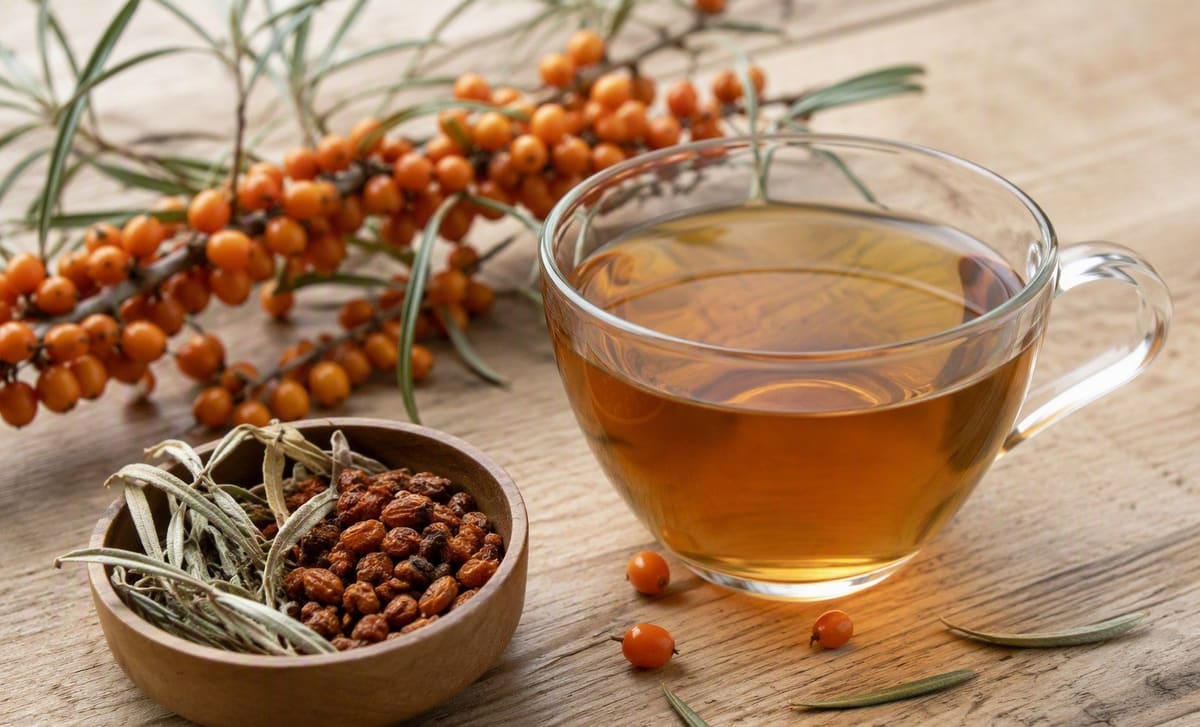
There is no best sea buckthorn tea we can name, because no product we checked earned a score: the category is mostly flavored blends where sea buckthorn is a minor ingredient, and no trial has tested tea for any health outcome. Buy it as a tart, pleasant drink using the label checklist below. For the studied benefits, tea is the wrong form entirely.
Why there is no winner here
Our rubric requires a product to state what is inside, prove sourcing, and offer honest value. The sea buckthorn teas we reviewed failed on the first point: most are herbal blends with sea buckthorn somewhere down the ingredient list, flavoring more than content. The few single-ingredient options came from sellers we could not verify. Rather than crown a mediocre winner, we are giving you the filter we used.
The three kinds of sea buckthorn tea
Dried berry tea. Cut and dried berries, sometimes mixed with the pulp. This is the version with some vitamin C in the cup, because vitamin C is water-soluble and steeps out. Drying already cost the berries part of their vitamin C before your kettle got involved, so keep expectations modest.
Leaf tea. Dried sea buckthorn leaves, traditional in parts of Asia. Leaves carry flavonoids rather than vitamin C, and essentially none of the berry’s oil. A fine herbal infusion, but it shares almost nothing with the berry research.
Flavored blends. Black, green, or herbal tea where sea buckthorn adds tartness and marketing. Check the ingredient order: if sea buckthorn sits third or lower, you are buying a pleasant blend, not a sea buckthorn product.
What you can honestly expect
A tart, fruity, slightly sour drink that works hot or iced. Some water-soluble compounds from the berries. That is the whole list. The studied benefits you have read about, dry eyes, skin hydration, vaginal dryness, came from the berry’s oil dosed at 1 to 3 grams a day in human trials. Hot water does not extract oil, so tea cannot reproduce those results for you. Our forms comparison maps which forms carry the research and which carry the refreshments.
The label checklist
If you buy sea buckthorn tea anyway, and many people enjoy it, run these four checks:
- Ingredient order. Sea buckthorn (berries or leaves, named explicitly) should lead the list, or at least sit second.
- The plant part. Berries and leaves are different products. A label that does not say which one is hiding the cheaper answer.
- Organic certification with a named certifier, since teas concentrate whatever the plant grew in.
- No health claims on the box. A tea promising the oil trial results is telling you it will borrow any evidence to make a sale.
Apply the checklist to whatever that search returns. We would rather send you shopping with a filter than with a fake ranking.
What a good cup costs
Tea is a grocery, so judge it by grocery math: price per cup. A 50 g pouch of dried berries steeps roughly a tablespoon at a time, which works out to a couple of weeks of daily cups. Anything priced like a supplement is a red flag in a teabag, and anything promising supplement results is a bigger one.
Common buying mistakes
- Paying sea buckthorn prices for a flavored blend where the berry sits fourth on the ingredient list.
- Buying leaf tea for vitamin C. Leaves carry flavonoids, not the berry’s vitamin C.
- Trusting health claims printed on the box. No tea has been trialed for any outcome.
- Brewing it like black tea. Boiling water and long steeps cost vitamin C. Hot, not boiling, ten minutes, per the tea-making guide.
The 60-second decision path
- Goal check: a pleasant tart drink, or the studied benefits? Drink stays here, benefits go to the oil guide.
- Berry or leaf, stated? Unstated stops the evaluation.
- Sea buckthorn first or second on the ingredient list? Lower means a flavored blend, priced accordingly.
- Organic certifier named? Teas concentrate whatever the plant grew in.
Reading what you actually bought
Berry teas come as cut-and-sifted pieces or as fine dust in teabags. The pieces steep slower and store better. The dust steeps fast and stales fast, and teabag pricing per gram is often the worst in the category. Leaf teas should name the leaf on the label, often as Hippophae rhamnoides leaf, which at least proves the plant. One caffeine note: berry and leaf teas are naturally caffeine-free, while blends built on black or green tea carry caffeine from the base, so check the base if you drink late.
Iced, blended, and in the kitchen
Berry tea iced is genuinely good, tart like a light hibiscus. It also blends well: a spoon of dried berries alongside rooibos or mint stretches the pouch and softens the sour. In the kitchen, a strong brew can replace part of the liquid in a smoothie, per the smoothie recipes.
Storage and the honest cupboard life
Dried berries and leaf tea want airtight containers, dark, dry, and cool, the same rules as any dried botanical. Vitamin C fades with months of shelf time, so buy small pouches often rather than a tin for the year. Brewed tea keeps a day in the fridge and makes a decent iced version. The storage page covers every form, and the tea recipes show two tested brews.
The honey question
Sweetening is personal, and honey is the traditional partner because its richness rounds the acid rather than just masking it. Stir it in after brewing, not during the steep, and keep the jar for the cup, not the infant in the family: honey is never for babies under 12 months. Our infused honey recipe makes a sea buckthorn version if you want the pairing bottled.
Who should skip tea
Benefit-seekers first: the trials used oil, and tea cannot deliver oil. Enamel-sensitive and reflux-prone drinkers second, because the berry is seriously acidic even diluted. And anyone who wants one product to do everything: tea is a pleasure, hire it for that.
If you want the actual studied benefits
Tea will not get you there. The forms that match the human trials are the oil and oil softgels scored in our oil guide and capsules guide, at the doses on the how much per day page. Keep the tea for pleasure, and let the oil do the work.
Tea is a food, so supplement cautions mostly do not apply. If you also take sea buckthorn oil alongside blood thinners, or you are pregnant or nursing, read our safety notes and talk to your doctor.
Frequently asked questions
Does sea buckthorn tea have health benefits?
No human trial has tested sea buckthorn tea for any health outcome, so honest advice stops at what is in the cup: a tart drink with some water-soluble compounds from the berries or leaves. The studied benefits (dry eyes, skin, vaginal dryness) came from the oil in gram doses, which tea cannot deliver.
Does sea buckthorn tea contain vitamin C?
Some, if the tea contains actual dried berry pieces. Vitamin C is water-soluble, so it steeps into the cup, but heat and the berry's drying losses mean the total is modest next to fresh berries. Leaf-only teas contain far less.
Is sea buckthorn tea safe to drink every day?
As a food, yes for most people: a cup or two of berry tea is a tart drink, not a dose of anything concentrated. The acidity argues for drinking it with food and rinsing your mouth with water after, the same rule as juice. Supplement-level cautions apply to the oil, not the teacup.