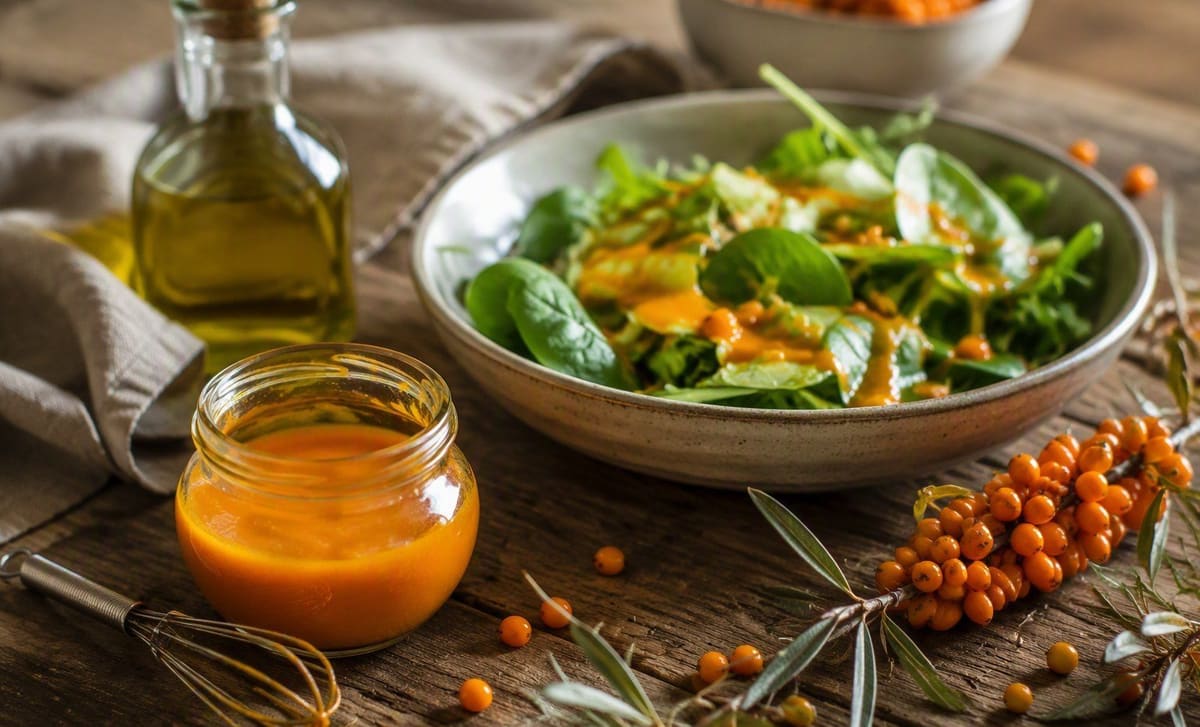
Sea buckthorn was made for salad dressing: the juice replaces vinegar or lemon with something fruitier, and a teaspoon of the oil turns the whole bowl sunset orange. Two five-minute versions here, one sharp and one creamy, both balanced so the acid enhances instead of attacks.
Of the savory ideas on the recipes hub, this is the one that gets made every week.
Version 1: the sharp vinaigrette
Yield: about 150 ml, enough for a week of salads.
- 30 ml sea buckthorn juice (2 tablespoons)
- 90 ml mild olive oil (6 tablespoons)
- 5 ml sea buckthorn oil, optional (1 level teaspoon, roughly 4.5 g)
- 1 teaspoon honey (about 7 g)
- 1 teaspoon Dijon mustard
- A pinch of salt
Add everything to a jar, lid on, shake hard for ten seconds. Taste on a leaf, not a spoon: dressing should taste slightly too strong on its own. Keeps a week in the fridge. Shake again before each use.
Version 2: the creamy yogurt dressing
Yield: about 150 ml.
- 100 g Greek yogurt
- 20 ml sea buckthorn juice (4 teaspoons)
- 10 ml olive oil (2 teaspoons)
- 1 teaspoon honey
- Salt, and dill if you have it
Whisk everything smooth. Thicker than the vinaigrette, gentler on bitter leaves, and very good on slaws. Keeps three to four days in the fridge.
Version 3: the orange tahini
Yield: about 120 ml, dairy-free.
- 2 tablespoons tahini (about 30 g)
- 20 ml sea buckthorn juice (4 teaspoons)
- 20 to 30 ml water, added slowly
- 1 teaspoon honey
- Salt
Whisk the tahini and juice first. It seizes into a paste, then relaxes into cream as you add the water a spoon at a time. The same fat-meets-acid logic as the yogurt version, with a sesame depth that loves roasted vegetables, grain bowls, and falafel-adjacent situations.
Troubleshooting
- The vinaigrette splits. Mustard is the emulsifier. Add another half teaspoon, shake harder, and accept that a shake before each use is the nature of the thing.
- Too sharp. Raise the oil, then the honey a half teaspoon at a time. Berry batches vary in acidity, so the dial exists.
- The yogurt dressing is too thick. Water, a teaspoon at a time, whisked in. It thins fast, so go slowly.
- The olive oil went solid in the fridge. Normal behavior. Ten minutes on the counter and a shake brings it back.
The pairing logic
Acid needs fat and fat needs acid, which is the entire design. Sharp dressings belong on sturdy leaves, beets, nuts, and cheese, anything that argues back. Creamy dressings belong on delicate leaves, slaws, and cucumber, anything that would rather be coated than challenged. Dress the salad two minutes before it goes to the table, not twenty, because acid wilts greens on a schedule. A spoonful of infused honey in place of plain honey doubles the berry note, and the warm sauce is the cooked cousin of the same balance.
Where they shine
The vinaigrette wants sturdy greens, beets, goat cheese, and walnuts. The yogurt version wants cabbage, carrots, and anything crunchy. Three full salads that use them are on the salads page, the oil explainer covers the teaspoon of berry oil, and the juice recipes supply the acid. Freshness is the whole flavor in a raw dressing, so our tested oil picks are worth a look before a tired bottle flattens a good salad. The cooking guide explains why acidity and fat belong together.
The fridge math and the leftover move
The vinaigrette’s week of fridge life covers about four big salads at the 45 ml rate, so one Sunday shake carries a workweek. The yogurt and tahini versions are three-to-four-day dressings, which means smaller batches made twice. Leftover vinaigrette also works warm: a spoon whisked into the pan juices after roasting vegetables is the fastest pan sauce you never planned.
Frequently asked questions
Can you use sea buckthorn oil in salad dressing?
Yes, and it works well. Use about 1 level teaspoon (5 ml, roughly 4.5 g) as a minority of the total oil, because it is intensely flavored and stains everything orange. Let the juice do the acid work and the berry oil add color and carotenoids.
Why does my vinaigrette keep separating?
Because oil and acid refuse to stay mixed, and every vinaigrette separates with time. Mustard is the glue that slows it down, so add another half teaspoon and shake harder. Separation in the fridge is normal, not spoilage. Shake before every use and it is as good as new.