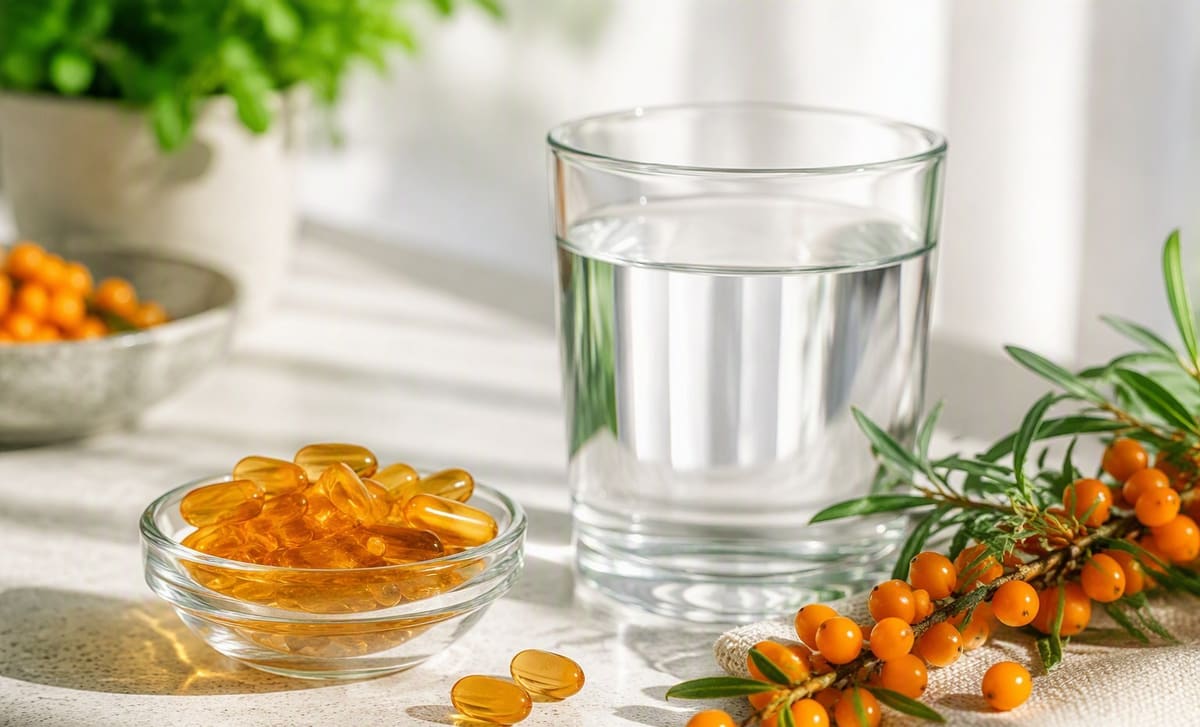
Take sea buckthorn capsules with food, split across two meals, the way the trials dosed them. Four standard 500 mg softgels a day reaches the studied 2 grams. One capsule a day, the dose most labels suggest, is a quarter of what was tested and explains most disappointed reviews.
The daily routine
- Check the oil per softgel. Labels list milligrams of oil per capsule, commonly 500 or 1,000 mg. This number drives everything below. If the label hides it, that is a red flag, and our capsules explainer shows what to look for instead.
- Count up to your target. For the studied 2 grams: 4× 500 mg or 2× 1,000 mg. For the 3-gram vaginal-health dose: 6× 500 mg. The full map of doses per goal lives on the how much per day page.
- Split it morning and evening. The dry-eye trial dosed 1 gram twice daily with meals, and the other trials followed the same pattern. Splitting keeps levels steadier and is gentler on the stomach.
- Take it with food. The fatty acids and carotenoids are fat-soluble, so a meal with some fat helps them absorb. Breakfast and dinner cover the split naturally.
- Give it twelve weeks. The trials measured at week 12. A verdict at week 2 is noise, whatever direction it points.
What not to do
- Do not follow a one-a-day label. One 500 mg softgel delivers a quarter of the lowest studied dose. Under-dosing, not the plant, is why “it did nothing” reviews exist.
- Do not take them dry on an empty stomach. You lose absorption and gain burps.
- Do not double up after a missed dose. Just take the next one with the next meal.
The travel note
Capsules are the portable form for a reason: no measuring, no staining, no refrigeration, and airport security does not care. Keep them in the original bottle, out of a hot car, and the routine survives any trip. Verified picks with the oil content already counted are in the capsules buying guide.
Reading the label like a skeptic
Three numbers matter on a capsule label, and only one is usually printed large. Oil per softgel: 500 mg is standard, 1,000 mg exists. Which oil: berry, seed, or a blend, and the two oils are not interchangeable, per the seed vs berry page. What else is inside: some brands pad with cheaper carrier oils, which dilutes the sea buckthorn content of every softgel. A label that hides any of the three is telling you something.
The burp problem
Oil capsules occasionally repeat on people, and the fixes are mechanical. Take them mid-meal rather than before or after, so food sits on both sides of the oil. Split the dose so no single meal carries more than two softgels. If burps persist at the full dose, move the larger share to the evening meal. Persistent reflux-type symptoms are a different conversation, and the acid reflux page covers who should pause.
Capsules versus liquid, honestly
Capsules win on convenience, taste, travel, and label math. Liquid oil wins on cost per gram and flexibility, because 2.2 ml measured once is the same 2 grams without swallowing four softgels. Neither form absorbs better than the other in any study we have. Pick the one you will still be taking in week ten, which is the only version of this question that matters.
The twelve-week supply math
The studied routine runs 84 days. At 4× 500 mg softgels a day, that is 336 softgels, or roughly three standard 120-count bottles. At 2× 1,000 mg, half that count. Knowing the total before you start prevents the classic failure mode: running out at week nine and calling the experiment finished. The storage page covers keeping softgels cool and dry for the full run.
Timing, briefly
With food, split morning and evening. The full reasoning lives on the best time page, and the one-sentence version is: consistency beats o’clock.
The tolerance ramp
If four softgels a day sounds like a lot, ramp it. Week one: one softgel with breakfast and one with dinner, confirming your stomach is on board. Week two onward: the full studied count. Ramping changes nothing about the twelve-week verdict, because the trials measured at week 12 either way, and a comfortable start is the one you keep.
The taste workaround
Even capsules occasionally leave a faint earthy aftertaste, and the fix is the meal itself: take them mid-bite rather than before the first one. Yogurt and other thick foods coat particularly well. If the taste persists through every trick, liquid oil stirred into a smoothie hides better than any softgel.
When capsules are simply wrong
Anyone who cannot swallow softgels, anyone on a fat-restricted medical diet, and anyone whose prescriber wants them off concentrated oils: capsules are the wrong form, and the how-to-use hub walks through the food forms that carry the rest of the plant’s case.
Frequently asked questions
Should I take sea buckthorn capsules with food?
Yes. The fatty acids and carotenoids are fat-soluble, so a meal with some fat improves absorption. Every human trial dosed with meals, typically split across two of them.
How many sea buckthorn capsules should I take a day?
Match the studies: 2 grams of oil daily, which is 4 standard 500 mg softgels or 2 larger 1,000 mg servings. Check your label's oil per softgel first, because capsule size and fill vary between brands.