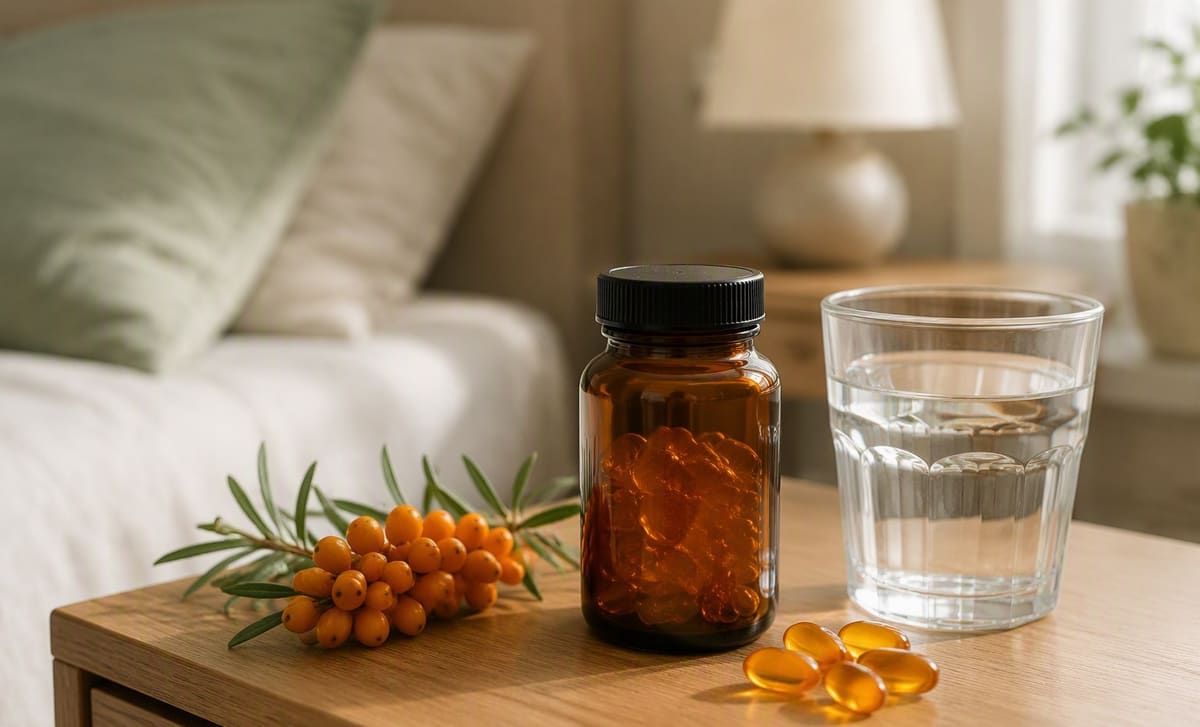
Membrasin is the dryness specialist of the sea buckthorn shelf: an oil supplement built around mucous membranes, sold hardest for dry eyes, and formulated with a named CO2 extract called SBA24 alongside lutein and zeaxanthin. Its label prints an omega-7 figure in milligrams, which most rivals will not do. It scores 7.1 in our rubric, held back by documents we could not find rather than by anything we found.
Research-based review per our editorial policy. We have not taken this product. Everything below comes from the brand’s own published product information and from studies we have opened ourselves, and company claims are labeled as exactly that.
The scorecard
| Criterion | Weight | Membrasin result | Score |
|---|---|---|---|
| Purity and sourcing | 30% | Named CO2 extract, no plant part or origin published | 7.0 |
| Fatty acid profile | 25% | Omega-7 printed in milligrams, rare on this shelf | 8.5 |
| Third-party testing | 20% | No published certificate of analysis found | 6.0 |
| Value | 15% | No verified price, and the daily oil dose sits under the trial dose | 6.5 |
| Transparency | 10% | Strong numbers, missing plant part and species binomial | 7.0 |
Those five weights are not tuned to this brand. Every brand we cover meets the same rubric, which is what makes a 7.1 mean something next to a 9.0 or a 6.8.
What we verified
- The positioning. Mucous membranes, framed around dryness, with dry eyes as the headline use and a companion eye spray sold as the second half of a two-step routine.
- The oil. The ingredient list leads with SBA24 sea buckthorn oil at 70 percent of the capsule contents, described as a CO2 extract. CO2 extraction is the method our oil explainer rates highest, so that is a real point in its favor.
- The numbers. The published label states 700 mg of oil at the two capsule dose and 1,400 mg at four, with omega-7 given as 300 mg and 600 mg respectively. Printed milligrams beat “rich in omega-7” every single time.
- The rest of the formula. Lutein and zeaxanthin, vitamin E, and beta carotene ride along, so this is a multi-ingredient eye supplement rather than a plain sea buckthorn softgel.
- What we could not verify. A certificate of analysis, the plant part (berry, seed, or blend), the growing origin, the species binomial on the ingredient list, and any current price.
The arithmetic the label does not do for you
Two label numbers, one division, and you learn something the brand does not print. 300 mg of omega-7 out of 700 mg of oil works out to roughly 43 percent of the oil. Our canonical range for berry and pulp oil is 15 to 54 percent across the species, with typical commercial oils landing at 30 to 40, which puts this figure above the usual commercial band and inside the natural one. Read plainly, that implies a berry-dominant oil rather than seed oil, which carries almost no omega-7 at all.
The brand does not say that, though, and an implication is not a declaration. The berry versus seed page explains why the distinction changes what is in the bottle more than any other label line, and a product this focused on omega-7 should simply name the plant part.
The dose question, and why it matters here
The dry-eye evidence everyone quotes used 2 grams of oil a day for three months. This product’s stated routine is two capsules twice daily to start, then two to four a day, which delivers 700 to 1,400 mg of oil. At 350 mg of oil per capsule, matching the trial’s 2 grams would take about six capsules a day, more than the label’s own upper number.
Two honest caveats sit on that comparison. The trial used a seed and berry blend, so matching grams is not the same as matching the tested oil. And the trial tested sea buckthorn oil alone, not a formula carrying lutein, zeaxanthin, and beta carotene. The full picture is on our dry eyes page, and the eyes hub holds the rest of the ocular evidence.
The SBA24 connection, stated carefully
SBA24 is a trade name for a branded sea buckthorn oil, and it is the same name attached to the oil used in the Yang 2009 skin study we cite across this site. There is a small tell for how close that relationship runs. The copy of that 2009 paper this site links to sits at a URL whose path reads “membrasin”, which is not where a neutral archive would file it. We would rather point that out than cite it quietly.
Now the limits. A shared trade name across a decade and a half is not proof that today’s capsule matches the 2009 study material. The dry-eye trial we lean on hardest describes its oil as a seed and berry blend and we could not verify which branded oil it used, so nobody should read the Larmo result as a trial of this product. And Yang 2009 is graded moderate on our scale for good reasons: its oral arm had no placebo group, and it was industry-linked. The company’s own line that SBA24 is the world’s most researched sea buckthorn oil is a marketing claim, and the product page we read named no studies at all to support it.
Where Membrasin falls short
Documents. The label reads better than most and the paperwork behind it is harder to find. No published certificate of analysis surfaced, no plant part is named, no origin is stated, and the species binomial does not appear in the ingredient list where it belongs. Our rubric pays for checkable documents, not brochures, which is exactly why third-party testing scores 6.0 and drags a genuinely good label down to 7.1.
Membrasin side effects, honestly
We have not taken this product, so anyone searching membrasin side effects will not find a first-hand account here. What we can give is the category picture, which applies to any concentrated sea buckthorn oil.
- Bleeding risk. Sea buckthorn berry oil at 5 g/day cut ADP-induced platelet aggregation in a small crossover study of 12 healthy men. That is a signal, not proof, and it is why anyone on warfarin, aspirin, or clopidogrel should clear this with a doctor, and why the safety hub says stop high-dose oil about two weeks before surgery.
- Pregnancy and breastfeeding. No human trial has tested concentrated sea buckthorn oil supplements in pregnant or breastfeeding women, so the standard answer stands: ask your doctor.
- The other ingredients. This is not a single-ingredient product. If you already take an eye formula, check whether you are doubling lutein, zeaxanthin, or vitamin A activity from beta carotene before you stack them. That question belongs to the formula, not to the berry.
- General tolerability. Trials of sea buckthorn oil at 1 to 3 g/day for three months reported good tolerability. Long-term high-dose safety data does not exist, and we say so rather than filling the gap.
The cost-per-day question
We cannot print a verified cost per day for Membrasin, because we have no price we checked ourselves and prices move. That absence is itself the finding, and the 6.5 on value reflects it alongside the dose gap above.
Do the arithmetic at the point of purchase instead. Take the current price, divide by the days a bottle lasts at the dose you intend to take, and hold that number against our verified anchors of $0.75 a day for SeabuckWonders softgels and $0.60 to $0.83 a day for SIBU liquid oil. The cost-per-day tool runs the same math on any bottle. Two fair points in the brand’s defense: a multi-ingredient eye formula is not directly comparable to a plain oil softgel, and any bottle covers half as many days at four capsules a day as it does at two, so the dose you settle on moves the answer more than the sticker does.
How it compares
Against the specialists on our brands ranking, Membrasin wins on the printed omega-7 figure and loses on published testing. Against the mainstream value brands, it has a far more specific label and no lab story you can point at, which is the reverse of the NOW Foods trade-off scored in our NOW Foods review. What it has that almost nobody else does is a coherent single-problem focus. Most sea buckthorn brands sell everything the plant might do. This one picked dryness and built the formula around it, and that focus is worth something our rubric does not measure.
What would raise or lower the score
Raise it: a published certificate of analysis, the plant part named on the label, and a stated origin. Any one of those moves the 6.0 on testing or the 7.0 on purity, and all three together would put this brand in the conversation with the top tier. Lower it: dropping the milligram figures for adjectives. The printed numbers are carrying this score, and without them it would be a mid-6 like every other brand that will not commit to a measurement.
Who should buy it, and who should skip it
Buy it if dry eyes or general dryness is your actual reason for being here, you want the lutein and zeaxanthin in the same capsule, and you accept paying for a formula rather than a raw ingredient.
Skip it if you are dose-matching the trials, because you need a plain oil and a plant part you can read, and the capsules guide has scored options that print both. Skip it too if a certificate of analysis is your minimum bar, since we could not find one.
What to verify before you buy
Read the current label rather than any review, ours included. Confirm the omega-7 milligrams are still printed, look for the plant part and the species name, count how many capsules your intended dose needs per day, and work out the real cost per day from the price in front of you. Membrasin reviews on retail sites are customer impressions rather than measurements, and our rubric does not read them as evidence. If the numbers still hold when you check them, this is a well-labeled product with a missing paperwork trail, which is precisely what 7.1 is meant to say.
Frequently asked questions
Is Membrasin worth it?
It depends on what you want from it. The label does something most sea buckthorn brands refuse to do, printing omega-7 in milligrams, and the oil is a CO2 extract sold under a named trade name. What we could not find is a published certificate of analysis, the plant part, or an origin. It scores 7.1 in our rubric, and we have not tested it ourselves.
Does Membrasin help dry eyes?
No trial has tested this product. What exists is a 2010 randomized trial of 100 people that gave 2 grams a day of a sea buckthorn seed and berry oil blend for three months and found a smaller winter rise in tear film osmolarity plus lower worst redness scores, with most tracked symptoms unchanged. That is moderate evidence for sea buckthorn oil, not for any one bottle of it.