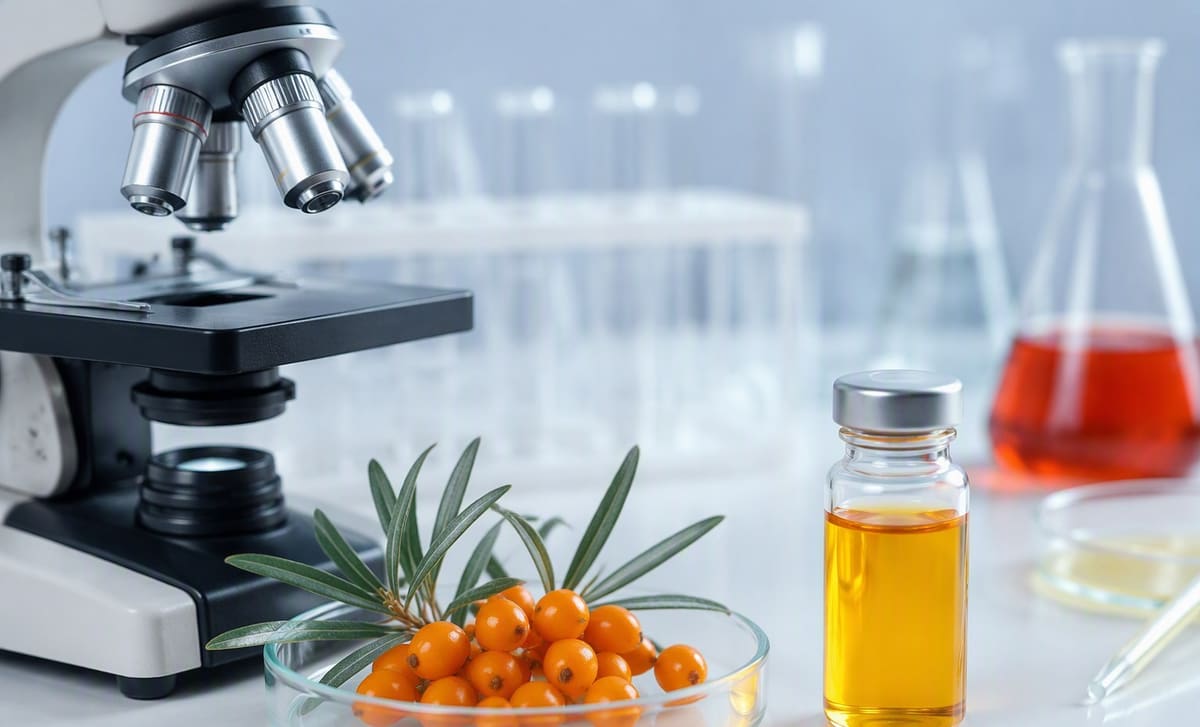
Everything published about sea buckthorn and cancer comes from laboratory dishes and animal models. No human trial has tested it for cancer treatment or prevention. Lab findings are how research questions are born, not how treatments are made, and no one should delay, skip, or replace cancer care because of a berry.
What the lab research actually shows
Cancer is the most sensitive claim we grade on our research section, so this page states the file plainly and claims nothing beyond it. The honest inventory, stated at the right volume. In cell cultures, sea buckthorn extracts, their flavonoids (quercetin, kaempferol, isorhamnetin), and some oil fractions slowed growth or triggered death in various cancer cell lines. Animal studies report slowed tumor growth or protection against some chemical exposures. Reviews of the plant’s pharmacology catalog these findings alongside its antioxidant chemistry.
Read at full strength, the file says the plant’s compounds are biologically active against cancer cells under laboratory conditions. Read at honest volume, it says the same sentence with the last five words doing all the work. Hundreds of vegetables, spices, and teas own an identical file, because almost any concentrated plant extract can stress a cancer cell sitting in a dish of it.
That is the whole file. Interesting, legitimate, early-stage science. It is also the same kind of file that exists for hundreds of plant compounds you have never heard of, because the distance from a petri dish to a patient is where most promising molecules go to fail.
Why cell studies cannot support human claims
Four gaps separate a dish from a person:
- Concentration. Cell studies bathe cancer cells in extract levels the human gut and bloodstream never reach from eating or supplementing.
- No metabolism. A dish has no digestion, liver processing, or immune system. The compound that touches the cell in a lab may never touch a tumor in a body.
- Translation failure. Most substances that kill cancer cells in vitro do nothing for patients, which is why the standard for human claims is human trials, and none exist here.
- Publication bias. Dishes that show an effect get published. Dishes that show nothing get filed away, so the visible literature overstates how often the compounds do anything at all.
What “supports research” on a label really means
Supplement labels sometimes carry phrases like “backed by research” or “studied for cellular health” near cancer-adjacent language. Translation: lab studies exist, the label cannot legally claim treatment, and the phrasing is engineered to let your hope fill the gap. When you see it, read “tested in dishes and rodents” and the product page becomes honest.
The review-paper engine
Search the topic and you will find hundreds of articles, which feels like depth and is mostly recycling. A small set of primary lab papers feeds a large set of reviews, each review citing the same cell lines and rodent experiments, and each new review making the file look bigger without adding a single new experiment. The 2011 pharmacology review in our sources is one of the most recycled of all. Counting articles on this topic measures the review industry, not the evidence. An honest count sounds different: dozens of primary lab papers, zero human trials, one very loud echo. That echo is why a search-result count is the weakest credential a claim can carry. The consumer cancer page applies the same filter in plain buyer language.
What would settle this, and why it may never exist
A human cancer-prevention trial needs thousands of participants, decades of follow-up, and a budget only governments and drug companies command. Drug companies spend it where patents protect the return, and a berry cannot be patented. The realistic ceiling for this file, for years to come, is exactly what it is today: lab findings that generate questions and no human trial that answers them. That is not a scandal, it is the normal economics of food research, and a food does not need to be a medicine to earn its place on the plate. The mechanisms page holds the same lab chemistry at proposal grade, no higher.
The questions patients actually ask us
Two arrive constantly, and both have the same shape. First: should I take antioxidant supplements during chemotherapy or radiation? That decision belongs to your oncology team, because questions like it are protocol-specific and only your team knows yours. Second: is there anything practical to know? One real detail: the highest-dose human study found reduced platelet aggregation at 5 grams of oil daily, so our own caution is to stop high-dose oil about two weeks before any procedure, and the surgery page explains the rule. For the one treatment-adjacent topic readers ask about most, mouth sores during cancer therapy, the mucositis page shows what little exists and how we grade it. Everything beyond those answers is individual medical advice, which no website can give.
A word for patients
If you or someone you love has cancer, this page changes nothing about your care, and that is the point. Oncology is one of the most evidence-driven fields in medicine, and your team has tools measured in survival, not in cell lines. Tell them about every supplement you take, sea buckthorn included, because interactions with treatment are their call to make. What you eat as food is a different question from what you take as a concentrated supplement, and your team can help you draw that line too. For the claims sea buckthorn genuinely has human trials behind, see the clinical trials catalog, and for how we grade every claim on this site, how we research lays out the method.
Frequently asked questions
Can sea buckthorn cure or treat cancer?
No, and no honest source can claim otherwise. The cancer-related findings for sea buckthorn come from cell cultures and animal models. No human trial has tested sea buckthorn for cancer treatment or prevention. If you are facing a cancer diagnosis, your oncology team's guidance outranks everything on this page, and you should tell them about any supplement you take.
What does the lab research on sea buckthorn and cancer show?
In cell cultures, sea buckthorn extracts and some of their flavonoids slowed or killed various cancer cell lines, and animal studies report related effects. These are real findings about how the compounds behave in dishes and rodents. Cell-study cytotoxicity does not predict human efficacy, the concentrations used rarely match what a person absorbs, and most compounds that kill cancer cells in a dish fail in people.
Is sea buckthorn safe to eat during cancer treatment?
Berries and juice as ordinary food are a different exposure from concentrated oil supplements, and the supplement question belongs to your oncology team, because they know your protocol and its specifics. The practical facts we can offer: no trial has studied sea buckthorn in cancer patients at all, and the high-dose platelet finding means we advise stopping supplements about two weeks before any procedure.