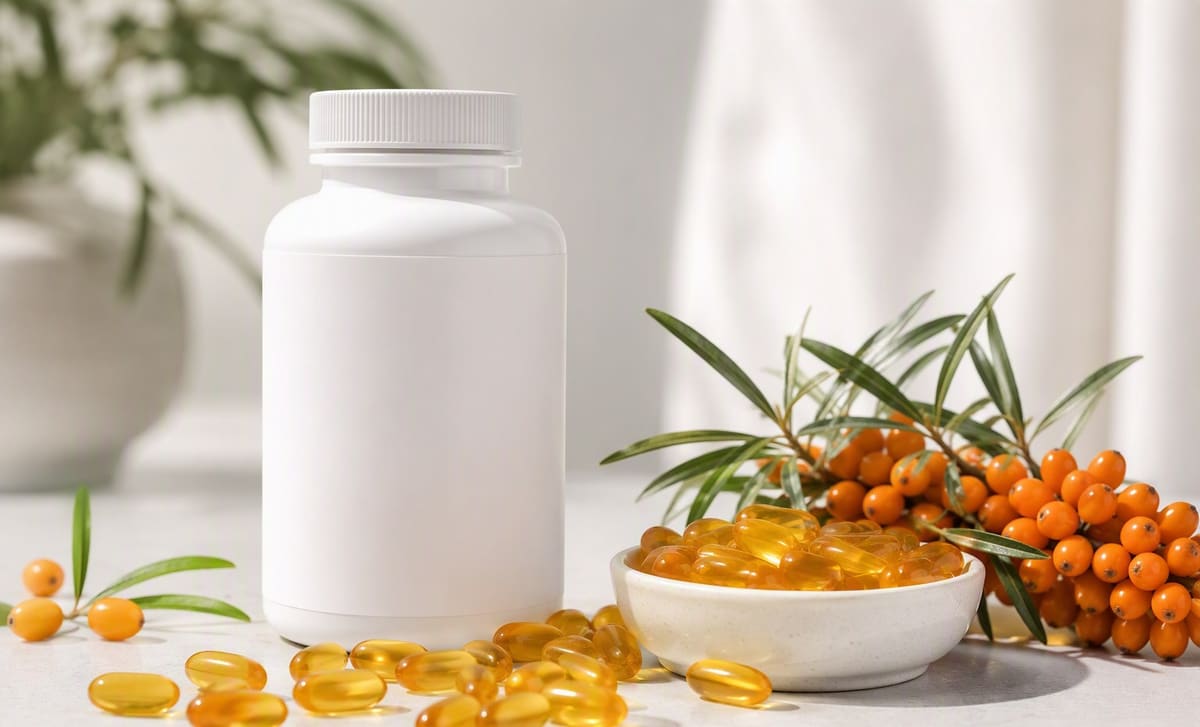
SeabuckWonders is the value champion of verified sea buckthorn: certified organic Himalayan oil, omega-7 percentages printed right on the supplement facts, CO2 extraction, and a $0.75 cost per studied day that nothing else we checked beats. It scores 9.0 in our rubric and wins our default recommendation.
Research-based review per our editorial policy. Prices checked July 2026.
The scorecard
| Criterion | Weight | SeabuckWonders result | Score |
|---|---|---|---|
| Purity and sourcing | 30% | Himalayan berries, certified organic | 9.0 |
| Fatty acid profile | 25% | 800/200 berry-seed blend, omega-7 % printed | 9.5 |
| Third-party testing | 20% | Organic plus kosher certification | 8.5 |
| Value | 15% | $0.75 per day at 2 softgels, best verified | 9.5 |
| Transparency | 10% | Exact mg and percentages on the panel | 9.0 |
Nothing else we have put through the same five-criterion gate has scored higher, and the 9.5 on value is most of the reason why.
What we verified
- Label transparency: the Omega-7 Complete panel states 800 mg organic berry oil (32 to 38% palmitoleic acid) plus 200 mg organic seed oil per 1,000 mg serving. You can check the omega-7 math yourself, which almost no competitor allows.
- Certifications: USDA organic and kosher.
- Extraction: supercritical CO2.
- Price verification: $44.86 for 120 softgels at Vitacost and $27.06 for 60 at iHerb at the time of checking.
The products we scored
- Omega-7 Complete (120 ct): best overall in the capsules guide and best value in the oil guide.
- Facial cream: our dedicated face cream pick in the skincare guide.
What you are buying under the name SeabuckWonders sea buckthorn oil blend Omega 7 Complete is exactly that, a blend, and blend is the word doing the work. It is 800 mg of berry oil to 200 mg of seed oil rather than one fraction on its own. That matters because the two fractions are not interchangeable. Berry oil is where the omega-7 sits, seed oil leans toward omega-3 and omega-6, and the seed versus berry oil page has the split. So a panel that names seed oil and stops is a different product from this one, whatever the front of the box says.
What we do not love
The softgel shell is beef gelatin, so vegans need the Barlowe’s option in the capsules guide. The skincare line is narrower than SIBU’s. And the 500 mg softgel size means 4-a-day dosing to match the 2-gram trials, per the dosage page.
Who should buy SeabuckWonders
Almost everyone buying a sea buckthorn supplement, especially dose-matching daily users who care about cost per day. If premium skincare systems or a wider topical line matter more, SIBU wins that lane, as the head-to-head breaks down.
The label, line by line
This is the panel that sets the category standard. Per 1,000 mg serving it states 800 mg organic berry oil at 32 to 38% palmitoleic acid plus 200 mg organic seed oil. Multiply it out and you get 256 to 304 mg of omega-7 per serving, a number you computed yourself from printed figures rather than a marketing claim you were asked to trust. That is why fatty acid profile scores 9.5 and transparency 9.0. Almost no competitor prints enough to allow the check. The panel also tells you the blend ratio, so you know you are getting a berry-forward mix rather than a seed-heavy one, and the certification line (USDA organic plus kosher) is printed for verification rather than decoration.
The cost-per-day question
At $44.86 for 120 softgels, the labeled 2-softgel day costs $0.75, the best verified figure we found. Matching the 2-gram trial dose takes 4 softgels, so $1.50 a day, still below SIBU’s equivalent at a matched dose. The 60-count at $27.06 is the smaller-commitment entry, though the 120-count wins on unit math. Two honest caveats. Prices move, so recheck before buying, and the cost-per-day tool will redo this arithmetic for any current price. And cost per day only matters against a dose you actually take, which the study dosages page lays out.
How it compares
Against SIBU, this is the value and transparency play: same Himalayan sourcing class, same CO2 extraction, better printed numbers, and roughly half the cost per studied day in supplement form. Against the mainstream tier of NOW, Nature’s Way, and Swanson, it is a different conversation entirely, with named origin and printed percentages the commodity brands do not offer. Nothing in that tier comes within two points of it on our scale. The head-to-head walks the SIBU matchup point by point.
What would raise or lower the score
There is little headroom left, and that is the point of a 9.0. The remaining gaps are the beef gelatin shell, which pushes vegans to the Barlowe’s option in the capsules guide, and a skincare line narrower than SIBU’s. What would lower the score: quieter panels. If the printed percentages disappeared from a future label revision, the 9.5 on fatty acid profile would fall fast, because the checkability is the score.
Who should skip SeabuckWonders
Vegans, because of the gelatin shell. Skincare-first buyers, because the topical line is focused rather than a system, and SIBU wins that lane. And anyone who wants a liquid oil for the kitchen or for topical use, since this brand’s strength is the softgel. Everyone else, particularly daily supplement users counting cost per studied day, starts here.
What to verify before you buy
Confirm the current supplement facts panel still prints the palmitoleic acid range, since that single line carries much of this score. Check the current price at both pack sizes and recompute the daily cost. If the panel and the math still look like what we verified, this remains the default pick on the brands ranking.
The 60-count or the 120-count
The SeabuckWonders Omega-7 Complete sea buckthorn oil sells in two pack sizes and we verified both: $44.86 for 120 at Vitacost and $27.06 for 60 at iHerb at the time of checking. Unit math favors the 120-count by a clear margin, and at 2 softgels a day it is a two-month supply. The 60-count is the low-commitment trial size. New to the brand: start small. Restocking: buy big.
Frequently asked questions
Is SeabuckWonders a good brand?
Yes, and it is our value leader. SeabuckWonders prints actual omega-7 percentages on its supplement facts, uses certified-organic Himalayan oil with CO2 extraction, and its 120-count Omega-7 Complete works out to $0.75 per day, the best verified cost per studied dose we found. It scores 9.0 in our rubric.
Is SeabuckWonders vegan?
The oil itself is plant material, but the Omega-7 Complete softgel shell is beef gelatin, so the supplement is not vegan. Vegan buyers should look at the Barlowe's Omegia option in our capsules guide, which uses a veggie capsule.