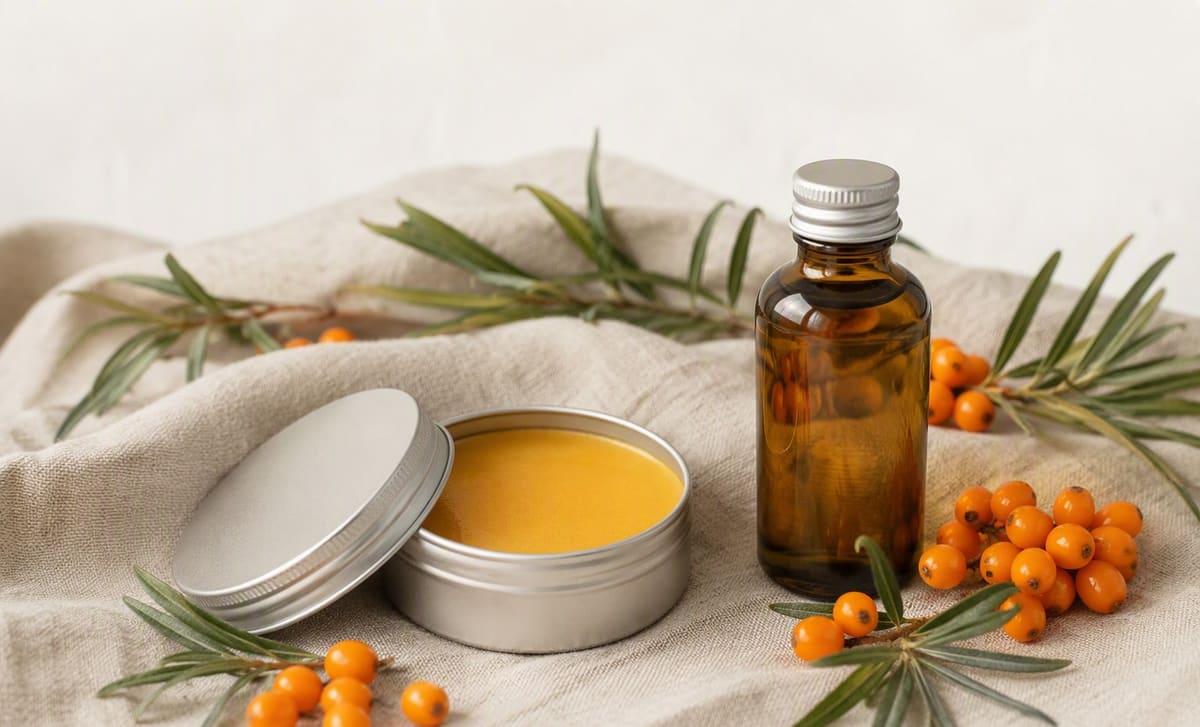
Badger is the certified-organic balm house: a US company with a genuine organic certification culture and B Corp status, where sea buckthorn shows up as an ingredient in balms and oils rather than as the headline. For topical buyers that heritage counts. It scores 7.5 in our rubric.
Research-based review per our editorial policy. We scored the sea-buckthorn-containing topical line, not the whole catalog.
The scorecard
| Criterion | Weight | Badger result | Score |
|---|---|---|---|
| Purity and sourcing | 30% | Certified-organic heritage, B Corp culture | 8.0 |
| Fatty acid profile | 25% | Sea buckthorn as balm ingredient, not a focus | 7.0 |
| Third-party testing | 20% | Organic certification culture across the line | 7.5 |
| Value | 15% | Fair for certified-organic topicals; check current price | 7.0 |
| Transparency | 10% | Full ingredient lists, long-standing openness | 7.5 |
Badger is one of the topical-only names on our scored brand list, which is why the fatty acid line reads the way it does.
What we verified
- The company: a US organic balms maker with certified-organic heritage and B Corp status it has long publicized.
- The line: sea buckthorn appears in balms and body oils as one botanical among several, not as a standalone focus.
- The relevance boundary: this is a topical-only story. Nothing in the line is a supplement, and we scored it accordingly.
The products in the line
- Sea-buckthorn-containing balms and oils: certified-organic topicals where the berry oil plays a supporting role. Check current price, and scan the ingredient list to see where sea buckthorn sits, since position tells you how much is in the tin.
Where Badger falls short
Focus. If you want a sea buckthorn-forward product or a measurable dose of the oil itself, a supporting ingredient in a balm is not that. The skincare guide compares topicals where sea buckthorn leads.
Who should buy Badger
Buyers who want certified-organic topicals from a company with a real certification culture, and who are happy with sea buckthorn in an ensemble role. Supplement seekers should head to the brands ranking, where the verified softgel and oil specialists live.
The label, line by line
A balm tin tells you more than a softgel bottle in one respect: full ingredient lists are the norm, and Badger publishes them, which is part of why transparency scores 7.5. Ingredient lists run in descending order by weight, so the position of sea buckthorn tells you roughly how much is in the tin. High on the list means a meaningful share. Down after the essential oils means a cameo.
What the tin cannot tell you is a fatty acid breakdown. Balms are not required to print one, and Badger does not. That single fact explains the 7.0 on fatty acid profile: the oil is present, but its dose is not measurable from the label. If a measurable dose is what you want, a balm is the wrong format entirely.
The cost-per-day question
Balms are not dosed like supplements, so cost per day works differently here. A tin used on hands or lips lasts weeks to months, which keeps the daily cost low even at certified-organic prices. And because a balm is often a shared, multi-use product, households can finish a tin faster than expected, which drops the cost per person further. The honest comparison is not against the supplement anchors we cite elsewhere on this site, like the verified $0.75 per day for SeabuckWonders softgels. It is against other certified-organic balms, and on that shelf Badger prices fairly, which is why value lands at 7.0. Check the current price per tin and the tin size before judging, since both move around.
How it compares
Within the topical lane, the documented anchors are Weleda at 8.5, the heritage body oil with decades of continuous sale, and The Ordinary at the budget end for a single-ingredient face oil. Badger sits between them: more certification culture than the budget pick, less sea buckthorn focus than a dedicated oil. The full ordering is on the brands ranking, and the Weleda review covers the heritage alternative.
The B Corp question
B Corp status and certified-organic heritage are the two pillars of this score, and they are worth defining. The first speaks to how the company operates. The second speaks to how the ingredients are grown and handled. Neither speaks to how much sea buckthorn is in the tin or what its fatty acid profile looks like. That is why a brand can be genuinely admirable and still land at 7.5 in a sea buckthorn rubric: we score the sea buckthorn, not the company.
What would raise or lower the score
Raise it: a formula where sea buckthorn leads the ingredient list rather than supporting it, or published fatty acid data for the sea buckthorn component. Either would move the 7.0 on fatty acid profile. Lower it: a reformulation that pushes the oil further down the list, or any erosion of the organic certification the score leans on. We recheck when we refresh this page.
Who should skip Badger
Anyone chasing omega-7 intake. A balm cannot deliver a measurable internal dose, no matter how good the certification. That is not a flaw in the product. It is a format boundary, and it is why supplement seekers belong on the capsules guide rather than here.
What to verify before you buy
Four quick checks on the brand’s current site or the tin itself. First, that the specific product you want actually contains sea buckthorn, since most of the catalog does not. Second, where it sits in the ingredient list. Third, the current price and tin size. Fourth, that the organic certification this score leans on is still in place. If all four check out and you want a certified-organic balm, this is a sound buy. If you want sea buckthorn as the main event, the skincare guide is the better map, and the choosing guide walks through format-first decisions.
Frequently asked questions
Does Badger make sea buckthorn products?
Yes, as an ingredient rather than a focus. Badger is a US organic balms company with a certified-organic heritage and B Corp status, and sea buckthorn appears in its balms and oils. For a topical with genuine organic certification culture, it scores 7.5 in our rubric. Supplement seekers should look elsewhere: this is a topical-only story.
Is Badger sea buckthorn oil a supplement?
No. Badger's sea buckthorn products are certified-organic balms and body oils for topical use only. Nothing in the line is dosed for internal use, so supplement seekers should look at the verified softgel and oil brands in our ranked list.