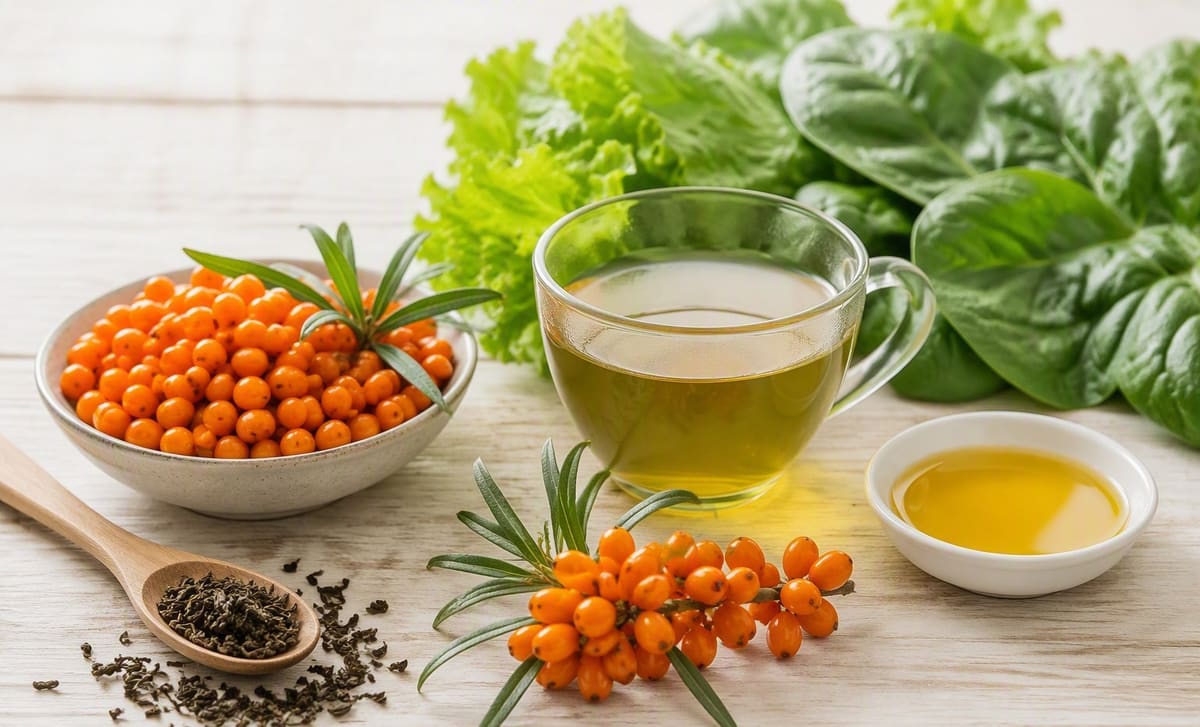
Every “sea buckthorn for liver” claim traces to animal studies. No human trial has measured sea buckthorn against liver fat, liver enzymes, or any liver outcome. Fatty liver disease has proven interventions, and they are weight loss and limiting alcohol. Sea buckthorn is a fine food and an unproven liver remedy, and those are very different things.
What the evidence actually contains
Mouse studies on sea buckthorn oil and fat metabolism exist, and they are the entire case. Animal liver data is hypothesis grade by definition: rodent livers, controlled diets, doses scaled to body weight that no supplement label matches. Our evidence standard treats these as reasons to run human trials, not reasons to buy products, and we rate them accordingly.
The human trial record covers lipids, dry eyes, skin, and vaginal health. Liver outcomes appear nowhere in it. The 2022 meta-analysis of 15 randomized trials found blood lipids improved, but it measured cholesterol panels, not liver fat, and better cholesterol numbers are not evidence of a liver treatment. The heart hub maps that lipid evidence honestly and stops there.
Why the lipid connection misleads
The marketing logic sounds tidy: fatty liver travels with abnormal lipids, sea buckthorn improves lipids, so sea buckthorn must help the liver. Each step sounds reasonable and the conclusion still fails, because nobody has measured the liver part. Imaging, liver enzymes, and histology are the outcomes that count, and no sea buckthorn trial has reported them.
What actually works for fatty liver
This part has real human evidence, and it is free to read. Sustained weight loss is the strongest intervention for non-alcoholic fatty liver disease, with meaningful improvement in liver fat and even histology at higher weight-loss percentages. Limiting alcohol protects the liver regardless of diagnosis. Managing blood sugar, blood pressure, and lipids with your doctor supports both. These are the treatments. Everything else is a companion at best.
If your liver enzymes came back abnormal, that result deserves a clinician’s interpretation, not a supplement. Fatty liver is usually silent until it is not, and early medical guidance changes the trajectory.
What a fatty liver actually is
Fatty liver is exactly what it sounds like: more than five percent of the liver’s weight stored as fat. The common form, now called MASLD, tracks with weight, insulin resistance, and abnormal lipids rather than with alcohol. It is usually silent, found on an ultrasound or an enzyme panel, and most of it never progresses. The minority that does progress moves through inflammation toward scarring over years, which is why the condition rewards early boring management and punishes neglect. It also rewards honesty about what has been tested, because nothing swallowed has a shortcut claim here.
The three tiers, sorted
- Real evidence: for sea buckthorn, none at the human level. The liver studies page files the full gap. For the condition itself, the proven levers are sustained weight loss, limiting alcohol, and managing the metabolic companions with your doctor.
- Plausible: animal studies on sea buckthorn oil and fat metabolism, plus the human lipid data, which is real but measures cholesterol panels, not livers. Plausible is the ceiling, and it is a low one.
- Marketing: “liver detox,” “cleanses the liver,” and any before- after ultrasound claim. The liver does not need detoxing, it needs the fat drivers removed, and no product page can say that sentence for you.
The numbers worth tracking
If your enzymes came back high, the useful numbers are the repeat panel, your weight trend, and whatever imaging your doctor orders. Improvement shows up there, over months, when the drivers improve. A supplement has never been shown to move any of those numbers for fatty liver, sea buckthorn included. The safety review does offer one reassurance: studied doses of the oil produced no liver-harm signal in the human trials, so the question is wasted money, not safety, for most adults. The weight loss page covers the one intervention that actually moves the condition, graded with the same honesty.
Common mistakes
- Treating the ultrasound instead of the drivers. The fat in the liver follows the metabolic pattern. Change the pattern and the picture follows.
- Buying “liver support” stacks. Ten untested ingredients are zero tested ingredients with a higher price.
- Delaying the follow-up. A single high enzyme reading deserves a recheck and a conversation, because the trajectory is the information.
Where sea buckthorn can honestly sit
As food or as a lipid-focused supplement your doctor approves, sea buckthorn fits beside the real interventions, the way any nutrient-dense food does. If the food route appeals more than the capsule route, the whole berries out of a freezer bag are the closest thing to fresh outside harvest season. The metabolic page gives the short version, and the safety hub covers who should check with a doctor first. What it cannot do is treat your liver, and any page claiming otherwise is selling against the evidence.
Frequently asked questions
Does sea buckthorn help fatty liver?
There is no human evidence that it does. The liver claims rest on animal studies, and no randomized trial has measured sea buckthorn against liver fat in people. The interventions with human proof for NAFLD are weight loss and limiting alcohol. Sea buckthorn is a reasonable food, not a liver treatment.
Is sea buckthorn oil hard on the liver?
No human trial has flagged liver harm at the studied doses of 1 to 3 grams of oil daily, and liver enzyme problems did not emerge as a signal in the pooled trial data. That is reassuring, not a guarantee: long-term use at high doses has simply not been studied. If you have existing liver disease, any concentrated supplement deserves your doctor's sign-off first.