
Meibomian gland dysfunction drives most evaporative dry eye, and sea buckthorn’s one good eye trial studied dry-eye patients broadly, not MGD specifically. That trial found oral oil slowed the tear-film osmolarity rise and reduced the worst redness and burning over three months. Warm compresses and lid hygiene remain first-line MGD care. The oil is the studied adjunct, not the replacement.
What MGD is, briefly
The meibomian glands line your eyelids and secrete the oily top layer of the tear film, the layer that stops tears evaporating. When those glands clog or their oil thickens, the tear film loses its seal, and eyes feel dry even when tear production is normal. That is evaporative dry eye, the most common form, and it is part of why long screen days can read as eye strain even when sight is fine. MGD care centers on the lids. The eyes hub maps every claim around it.
The trial, read in MGD context
The 2010 randomized, double-blind, placebo-controlled trial enrolled 100 adults with dry eye and gave half of them 2 grams of sea buckthorn oil daily for three winter months. Tear-film osmolarity rose in both groups with the season, but the rise was significantly smaller in the oil group. Maximum redness scores hit 6% of the oil group versus 36% on placebo, and maximum burning 12% versus 32%, though the burning gap missed significance once everyone assigned to the oil was counted. Most other symptoms showed no significant difference, which we publish because it is true.
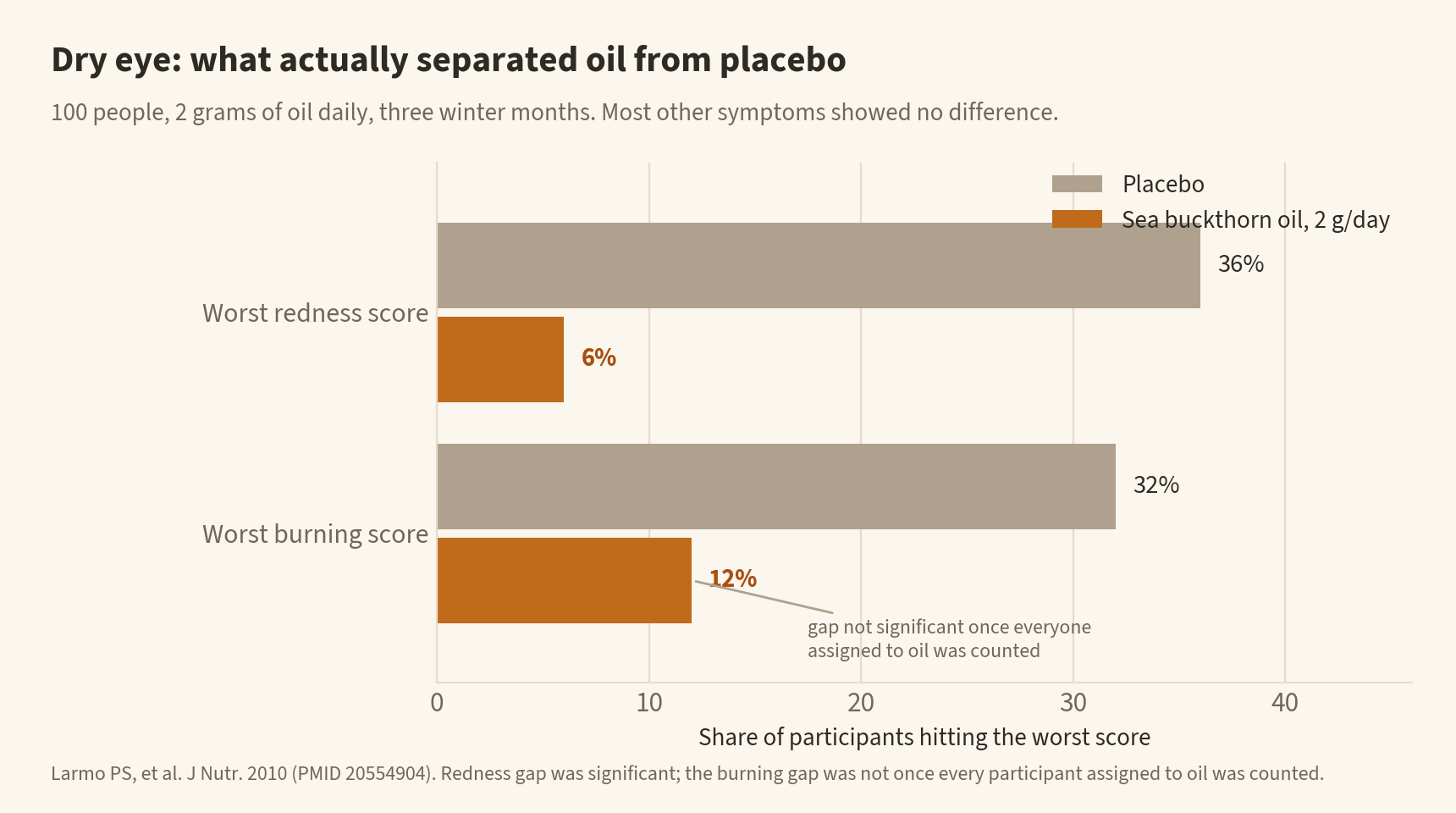
See the data behind this chart
| Worst score reached | Sea buckthorn oil, 2 g/day | Placebo |
|---|---|---|
| Redness | 6% | 36% |
| Burning | 12% | 32% |
The trial enrolled dry-eye patients by symptoms and osmolarity, not by gland imaging, so it cannot claim an MGD-specific effect. Given how much dry eye involves MGD, overlap is likely, but “likely overlap” is the honest phrase, and the dry eye page has the full study breakdown.
What stays first-line
MGD care starts at the lid margin: daily warm compresses to liquefy the gland oil, lid massage and hygiene to express and clean it, and ophthalmologist guidance for anything persistent. Those steps have the clinical track record. Oral sea buckthorn oil at the studied 2 grams daily fits alongside as the one supplement with a placebo-controlled dry-eye trial behind it, after your eye doctor knows about it.
Worsening pain, light sensitivity, or vision changes skip the supplement conversation entirely and go straight to an eye exam.
The lid-care routine, step by step
First-line MGD care is mechanical and daily. Warmth first: a warm compress over closed lids for several minutes to liquefy the thickened gland oil. Then gentle massage along the lid margin toward the lashes to express it. Then clean the margin. Done consistently, that sequence has the clinical track record. Done never, no supplement fills the gap, because the glands need physical expression, not just better chemistry.
Why an oral oil is the interesting adjunct
Artificial tears add fluid from the outside. An oral oil works from the inside, through the same mucosal membrane family that lines the eyes, which is the leading theory for the trial’s effect. That makes the oral route a plausible complement to lid care rather than a competitor to it: the compresses handle the glands’ plumbing, and the studied 2 grams a day addresses the tear film’s behavior over months. Plausible is not proven, and the trial remains a dry-eye trial, not an MGD trial.
What the trial can and cannot tell MGD patients
It can say that in 100 dry-eye patients, 2 grams daily for three months blunted the osmolarity rise and cut the worst redness (6% versus 36%) and burning (12% versus 32%). It cannot say it helped MGD specifically, because no gland imaging was done. Given how much dry eye involves MGD, overlap is likely, and likely is the word to hold onto. The dry eye trial page has the full methods if your doctor asks.
Talking to your eye doctor about it
Bring three numbers: the dose (2 grams daily, split with meals), the duration (three months), and the design (randomized, placebo- controlled, 100 adults). Ask whether it fits alongside your lid routine, especially if you take blood thinners, since high-dose berry oil showed a mild antiplatelet signal in a small study. A doctor who sees your preparation will give you a better answer than any page can, including this one. The dosage tool helps match the studied amount to a real product, and we ranked the sea buckthorn oils partly on how cleanly they reach 2 grams a day.
The compress, done right
The warm compress is the step people skip and the step that matters most, because thickened gland oil does not express cold. Several minutes of real warmth, then the massage, daily, is the routine with the track record. A supplement fits beside that habit. It does not stand in for it.
The honest bottom line
MGD care is lid care, proven and unglamorous, plus whatever your ophthalmologist adds for your case. Sea buckthorn oil is the one oral adjunct with a placebo-controlled dry-eye trial behind it, discussed with your doctor at the studied dose. That sentence is the entire evidence position, and the dry eye page covers the dose and the product math.
Frequently asked questions
Does sea buckthorn oil help MGD?
Possibly, as an adjunct. The 100-person dry-eye trial found 2 grams of oral sea buckthorn oil daily slowed tear-film osmolarity rise and cut the worst redness and burning over three months. Much evaporative dry eye involves meibomian gland dysfunction, though the trial did not measure MGD specifically. Warm compresses and lid hygiene remain first-line, guided by your eye doctor.
What is the first-line care for MGD?
Lid care: daily warm compresses to liquefy the gland oil, gentle lid massage and hygiene to express and clean the margin, guided by your eye doctor. Oral sea buckthorn oil at the studied 2 grams daily is an adjunct to discuss with them, not a replacement for the compresses.