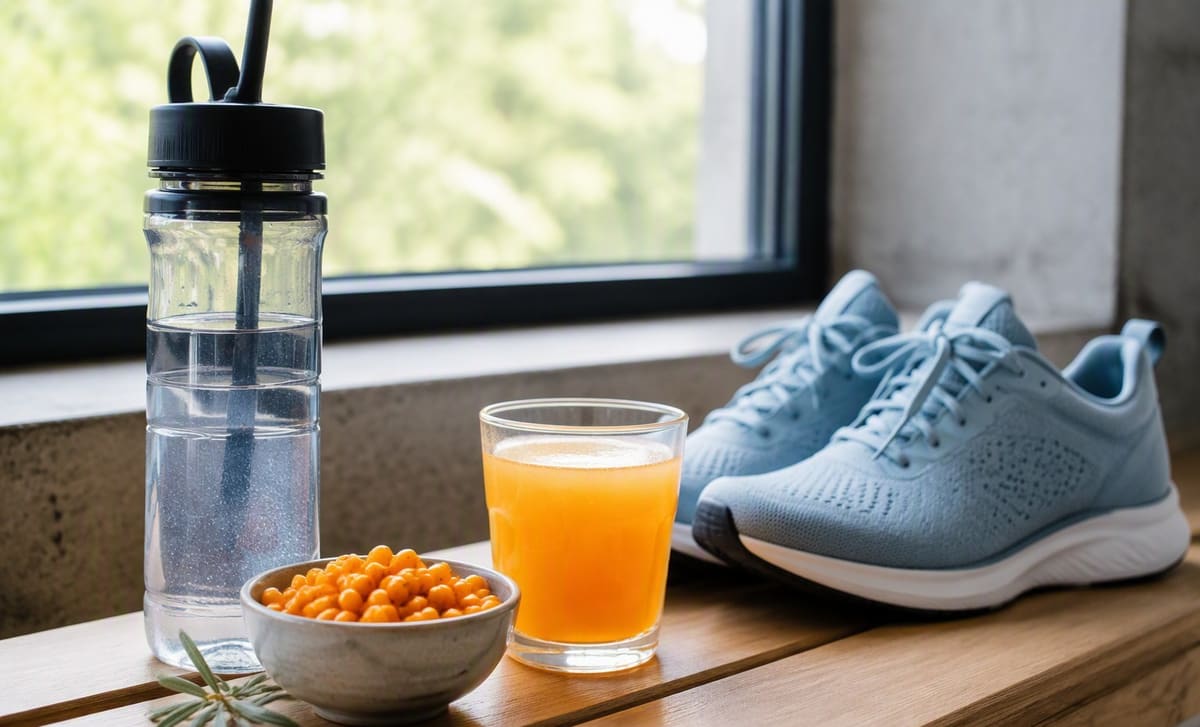
No human trial has tested sea buckthorn for athletic performance: not endurance, not strength, not recovery. Animal studies on physical stress exist and give the marketing its footnote. The performance tools with human evidence are training, protein, sleep, and creatine, in that order.
What the research actually contains
The performance-adjacent work is animal data. Studies reviewed by Suryakumar and Gupta found sea buckthorn preparations affected physical stress responses and high-altitude tolerance in rodents, which is why “adaptogen” language follows this plant around. Animal stress models are a legitimate research starting point and a terrible shopping argument. No runner, lifter, or cyclist has been measured in a sea buckthorn trial, and the men’s hub grades the claim accordingly.
The altitude research, fairly framed
The strongest-sounding performance evidence is the high-altitude work: rodent studies where sea buckthorn preparations changed stress responses under simulated altitude. Credit where due, that is a real research thread with real measurements, in animals. What it is not: a human endurance trial, a dosing guide, or a reason a runner should expect anything on race day. Altitude physiology in a rat cage and marathon performance in a human are separated by more than a species gap. They are separated by the entire experiment that has not been run.
The adaptogen label, unpacked
“Adaptogen” is the word doing the heavy lifting in performance marketing, and it is worth seeing clearly. The term dates to Soviet-era research on stress resistance, and it has no regulatory or clinical definition anywhere: no dose, no endpoint, no required trial. A substance earns the label by having any animal stress study and a marketing department. That is why the word appears on mushrooms, roots, berries, and tree bark alike. A category that fits everything describes nothing, and athletes should hear “adaptogen” as “untested in humans for performance” until a trial says otherwise.
What a real performance claim would require
The experiment that would change this page is easy to describe. Recruit trained athletes, randomize them to sea buckthorn or placebo, and measure endpoints that matter: time to exhaustion, VO2 max, strength, repeated sprints, recovery markers. Run it long enough to matter, then publish it. That trial does not exist in any registry this site could find. Until it does, every performance claim for this berry is an animal study wearing human clothes.
What actually works, ranked by evidence
Training structure comes first, because nothing outperforms progressive work. Protein at adequate daily intake supports recovery and adaptation. Sleep is the legal performance enhancer nobody buys enough of. Among supplements, creatine monohydrate carries the deepest human evidence file in sports nutrition, with caffeine behind it for acute performance. Every one of these has more human data than sea buckthorn has for any athletic outcome.
The supplement evidence ladder
Sports supplements sort cleanly by evidence depth. Creatine sits on top: hundreds of human trials, known effective doses, known responders, cheap. Caffeine follows, with acute effects on endurance and alertness measured in runners, lifters, and cyclists. Protein powder is food in convenient form, effective because total daily protein matters. Beta-alanine holds a narrow but real niche for high-intensity efforts lasting one to four minutes. Everything below those rungs shares a trait: the marketing outruns the measurements. Sea buckthorn is not on the ladder at all. It has never been measured against a single rung.
Vitamin C and recovery, honestly
The berry’s one legitimate sports-adjacent asset is vitamin C, at roughly 200 to 600 mg per 100 grams depending on source, as the vitamin C page details. Vitamin C participates in collagen formation, which matters for tendons and connective tissue, and food-level intake is unambiguously good. The caveat athletes should know: some training studies found that heavy antioxidant supplementation around workouts blunted parts of the adaptation signal, so megadose antioxidants are not a free upgrade. Food doses are not megadoses, which is one more argument for keeping the berry in the kitchen lane.
Where the berry can honestly sit
As food. A vitamin-C-rich juice or powder fits an athlete’s diet the way any nutrient-dense fruit does, and the nutrition hub covers the composition. Recovery is when nutrition earns its keep, and total daily protein matters far more than any exotic addition to it. Antioxidant marketing aimed at athletes also deserves a flag: heavy antioxidant dosing around training may blunt some adaptations in the research that exists, so more is not automatically better.
If you use it anyway
Keep it boring. Diluted juice with breakfast, powder stirred into yogurt, jam on the pre-race toast if your stomach already knows it. The straight juice is acidic enough that mid-workout is a bad place to meet it for the first time, and race day is never the moment for new foods. Expect nutrition, not performance. If you want a second powder with an actual evidence file, the spirulina comparison grades how another nutrient-dense staple stacks up against this berry.
The honest bottom line
Train, eat, sleep, and use the two supplements with real files if they fit your sport. Sea buckthorn belongs in the kitchen conversation, not the locker room one. The benefits hub shows what trials actually support.
Frequently asked questions
Does sea buckthorn improve athletic performance?
No human trial has shown it. Animal studies on physical stress and high-altitude tolerance exist, which is interesting and still animal data. What works for performance: training structure, protein, sleep, and among supplements, creatine has the deepest evidence file. Sea buckthorn is nutrition, not a performance enhancer.
Is sea buckthorn good before a workout?
There is no pre-workout evidence either way, because no trial has tested it around exercise. As food, a diluted juice fits a normal training diet, though the straight juice is acidic enough that many athletes would not want it sloshing in the stomach mid-session. The pre-workout window is one more place where the honest answer is: no data, keep it in the kitchen.