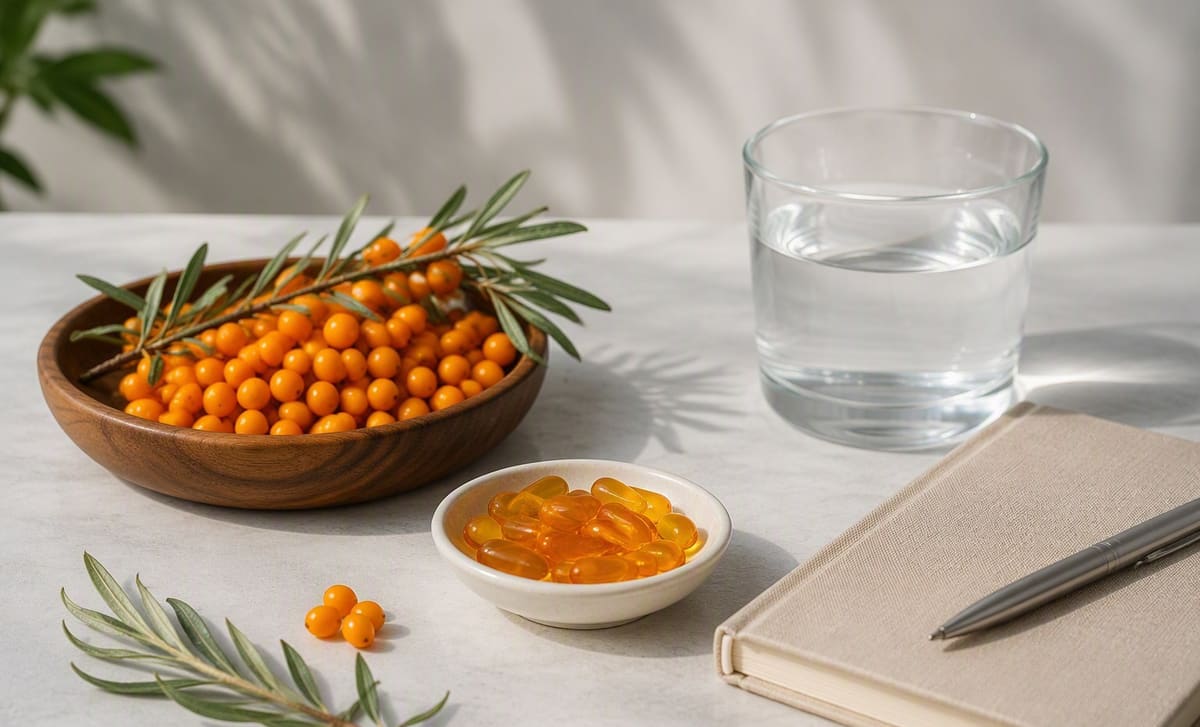
No trial has tested sea buckthorn for PCOS. The question exists because PCOS often travels with abnormal blood lipids, and sea buckthorn has real lipid evidence. Improving a cholesterol number is not treating a hormonal condition. PCOS management is medical and individual, and that conversation belongs with your doctor.
What PCOS actually is
Polycystic ovary syndrome is one of the most common hormonal conditions in women of reproductive age, affecting roughly one in ten. Diagnosis usually rests on a pattern: irregular or absent ovulation, signs of androgen excess like acne or extra hair growth, and polycystic ovaries on ultrasound, typically two of the three. Insulin resistance rides along in many cases, which is why cholesterol and blood sugar enter the conversation. It is also why management is individualized: two women with PCOS can need completely different plans, one focused on cycle regulation, another on metabolic risk, another on fertility. The women’s hub maps the claims that do have data behind them.
Why people connect the two
PCOS is a hormonal condition with a metabolic shadow: many women with it have abnormal cholesterol, insulin resistance, or both. Sea buckthorn has one of its strongest evidence grades in exactly that neighborhood. A 2022 meta-analysis of 15 randomized trials found it reduced triglycerides, total cholesterol, and LDL while raising HDL, with the clearest effects in people whose lipids were abnormal to begin with.
So the syllogism writes itself: PCOS involves bad lipids, sea buckthorn improves bad lipids, therefore sea buckthorn helps PCOS. The middle step is real. The conclusion does not follow, because PCOS is not a cholesterol problem. It is a hormonal condition whose risks include cholesterol, and nudging one risk marker is not treating the condition.
What the evidence actually covers
- Tested: blood lipids in adults, mostly people with abnormal levels at baseline. Sea buckthorn performed modestly well. The metabolic syndrome page grades that evidence in full.
- Tested and null: blood sugar, blood pressure, and body weight. The same meta-analysis found no significant effect on any of the three, which matters because insulin resistance sits near the center of PCOS for many women.
- Never tested: PCOS itself. No trial has enrolled women with PCOS and measured cycles, androgens, ovulation, or any hormonal endpoint.
The lipid conversation, scripted
If your lipid panel is part of your PCOS picture, sea buckthorn is a fair thing to raise with your doctor, framed correctly. The studied range was roughly 1 to 3 grams daily for one to three months, graded in detail on the cholesterol page. The script is short: “My LDL is up. I know this oil has modest lipid evidence. Is there any reason it clashes with my treatment?” That is a lipid question about a lipid product, and it keeps everyone honest. Turmeric’s curcumin has its own evidence file, compared on the turmeric page, and neither replaces a prescription when one is indicated.
The lifestyle core
The interventions with the deepest PCOS evidence are the least marketable. Regular movement, including resistance training, improves insulin sensitivity whether or not the scale moves. Sleep duration and regularity shape the same metabolic machinery. An eating pattern built around protein, fiber, and minimally processed food does more for androgens and insulin than any capsule studied. None of this is a moral lecture. It is the dose-response reality: lifestyle change is the treatment with trial support, and supplements are, at best, garnish.
The hormone claim, closed directly
Products marketing sea buckthorn for hormone balance are inventing data. In the vaginal dryness trial, the hormonal markers stayed flat, which was the point. Nothing in the human record shows sea buckthorn shifting estrogen, testosterone, or any hormone in anyone.
What to skip on the supplement shelf
Skip anything sold for PCOS that cannot name its trial: “hormone balance” blends, “ovarian support” formulas, detox kits. The genre borrows the same nutrient-list logic this page dissects above, and the price tags run high because the target audience is motivated. If a product cites sea buckthorn for PCOS, it is citing nothing, because the trial does not exist. Spend the budget on the appointment, the labs, and the groceries.
If fertility is the question
PCOS is one of the most common causes of irregular ovulation, and it is also one of the more treatable. Ovulation can often be induced medically, which is a doctor conversation with a genuinely good success record. The fertility page explains why supplements are not the path there, and the same holds here with extra force: the effective options are prescription-grade and well studied.
The honest position
If you have PCOS and abnormal lipids, sea buckthorn oil at studied doses (1 to 3 grams daily) is a reasonable thing to discuss with your doctor for the lipid part specifically, alongside the diet and movement changes that do the heavy lifting. For the condition itself, management is individualized and medical: cycle regulation, insulin-sensitizing treatment where indicated, and fertility planning when relevant. The safety hub covers the blood thinner and surgery cautions that apply before any supplement.
Frequently asked questions
Can sea buckthorn help with PCOS?
No trial has tested sea buckthorn for PCOS. The interest comes from its blood-lipid evidence, since many women with PCOS have abnormal lipids, but improving a lab number is not the same as treating a hormonal condition. PCOS management is medical and individualized, and no supplement replaces it.
Does sea buckthorn balance hormones in PCOS?
There is no evidence it changes hormone levels in anyone. In the menopause trial, hormonal markers of vaginal response stayed flat. Cholesterol effects from meta-analyses are real but modest, and they are lipid effects, not hormone effects.
What dose of sea buckthorn was studied for cholesterol?
The lipid trials behind the 2022 meta-analysis mostly used 1 to 3 grams of sea buckthorn oil or an equivalent berry preparation daily, for one to three months. If you have PCOS and abnormal lipids, that is the dose range to discuss with your doctor, for the lipid number specifically and alongside the diet and movement changes that do the heavy lifting.