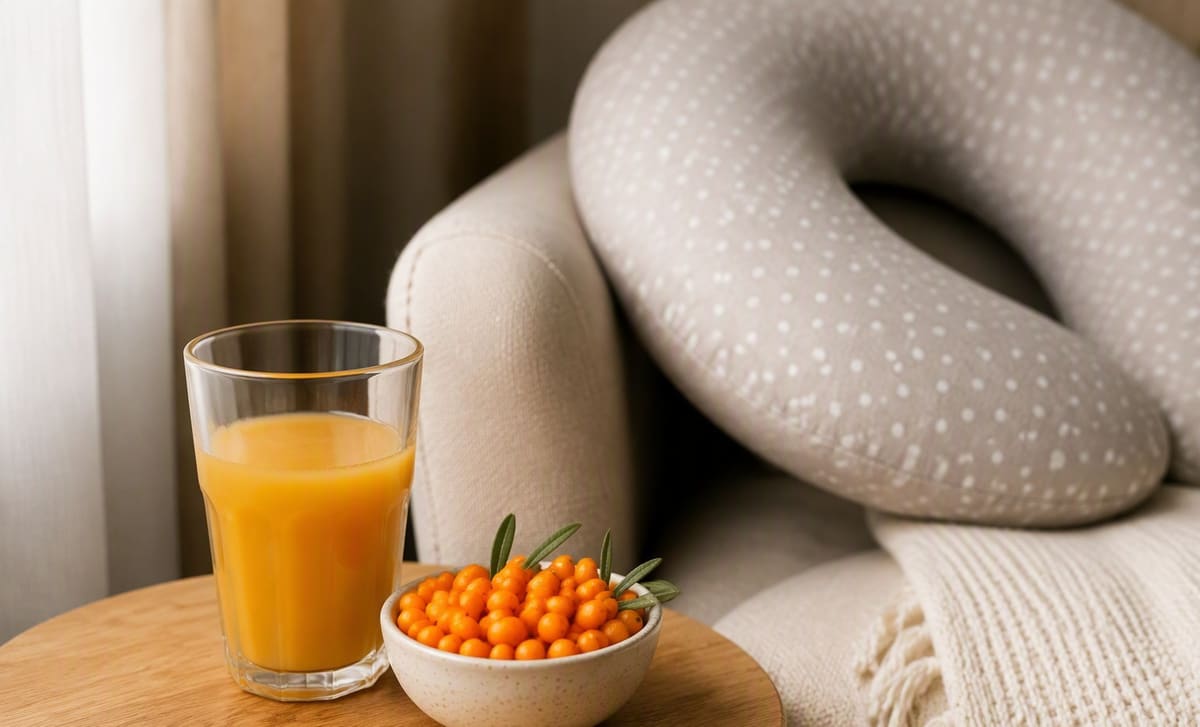
Sea buckthorn supplements are unstudied in breastfeeding. Nobody has measured the oil in lactating women, in their milk, or in their infants. The answer is unknown, not safe. Berries and juice in normal food amounts are fine as food. Concentrated oil supplements should wait until weaning, or until your own doctor says otherwise.
What is actually known
Very little, and precision matters here:
- No lactation trial exists. No study has dosed sea buckthorn oil in nursing mothers or measured anything in their milk or babies.
- Food use is unremarkable. The berry has centuries of food use, and berries or diluted juice in normal culinary amounts sit in the same category as any tart fruit.
- Supplements are a different exposure. The studied doses (1 to 3 grams of concentrated oil daily) are many times a food serving, and one small study at 5 grams daily found reduced platelet aggregation in healthy men. That finding is a signal about concentrated oil, and it is exactly the kind of unknown you do not route toward an infant. The women’s hub maps what the evidence does cover.
Why these trials do not exist
Researchers are not ignoring the question. A lactation trial would mean dosing mothers with a concentrated supplement and measuring what reaches the milk and the infant, and ethics boards do not approve experiments on infants without safety data, which is the very data that is missing. So the studies never start. This holds for nearly every supplement on the shelf, and it means “unstudied in breastfeeding” is usually a permanent label, not a gap someone is about to fill. Waiting for the trial means waiting for something that will not arrive.
Why “natural” does not settle this
Oil components eaten by the mother can and do appear in breast milk as a general rule of biology. Whether sea buckthorn’s specific compounds reach milk at meaningful levels has simply never been measured. The infant exposure question is unanswerable from data, which leaves two honest moves: avoid the exposure, or accept an unquantified unknown with your doctor’s knowledge. Guessing is not a third option.
What the food lane looks like in practice
Food amounts mean the amounts you would actually serve. A spoon of jam on toast. A splash of the juice stretched with water, because the straight juice is intensely acidic and dilution is the norm. A mug of berry tea. These are culinary exposures, the kind the berry has seen for centuries, and they carry a nutrient bonus: sea buckthorn is one of the richest common fruit sources of vitamin C, as the vitamin C page details. What the food lane excludes is the concentrate. One to three grams of oil in softgels is a pharmacological exposure dressed as food, and the platelet signal at 5 grams came from exactly that category.
What nursing mothers can use right now
One lane stays open: the skin. Topical sea buckthorn oil absorbs in trace amounts, far below anything a capsule delivers, and it is a legitimate comfort for the dry, stretched skin pregnancy leaves behind. The skin hub covers what topical use can and cannot do. One practical detail before you buy: berry oil and seed oil look and behave differently, and our comparison shows which of the two tints skin and fabric, which matters when a baby is pressed against you all day. Patch test first, keep it away from the chest area where the baby’s mouth goes, and file it under skincare, not treatment. For the shedding that arrives around month three, the postpartum hair page explains why that one is hormonal timing, not something any oil fixes.
The practical line
- Berries, juice, powder, tea: fine as food, in food amounts. The juice is very acidic, so dilute it, and our juice page sorts out which bottles are pure pressed berry and which lead with apple.
- Oil capsules and liquid oil supplements: hold off until weaning. The gap is months, and the unknown is total.
- If a supplement feels non-negotiable: that is a conversation for your doctor or midwife, who knows your history, not for a product page.
Reading the claims aimed at you
Product pages aimed at nursing mothers lean on words like “gentle” and “traditional”. Gentleness is not a measured property, and tradition involved berries, not softgels. The claims to watch for are “supports lactation” and “safe while nursing”, because no sea buckthorn product can support either from data. A seller who cannot show you a lactation study is asking you to run an uncontrolled experiment with your baby as the second participant. That is the whole calculus, and it points one way.
A script for the appointment
If a supplement still feels necessary, bring the question to someone who knows your history. The script is short: “I am breastfeeding, and I want to take sea buckthorn oil, 1 to 3 grams a day. There are no lactation studies. Is there anything in my file that says avoid it?” A doctor or midwife can check your medications, your bleeding history, and your baby’s situation in one pass. That two-minute conversation is worth more than any page on the internet, this one included.
The pregnancy page runs the same logic for the nine months before this one, the safety hub has the full caution list for everyone else.
Frequently asked questions
Can I take sea buckthorn oil while breastfeeding?
There is no data either way. No study has measured sea buckthorn supplements in lactating women or in their milk, so the honest answer is unknown rather than safe. Berries and juice in normal food amounts are fine as food. Concentrated oil supplements should wait until weaning, or until your doctor says otherwise.
Do sea buckthorn supplements reach breast milk?
Nobody knows, because nobody has measured it. Oil components do pass into milk in general, which is exactly why the unknown matters: the infant exposure question cannot be answered from data, only avoided.
Is sea buckthorn tea safe while breastfeeding?
Tea brewed from the berries or dried fruit sits in the food lane, and a normal cup is fine, the same category as the juice or the jam. What does not change is the supplement rule: concentrated oil capsules and liquid oil stay on hold until weaning or until your doctor clears them, because no study has measured them in nursing mothers or in milk.