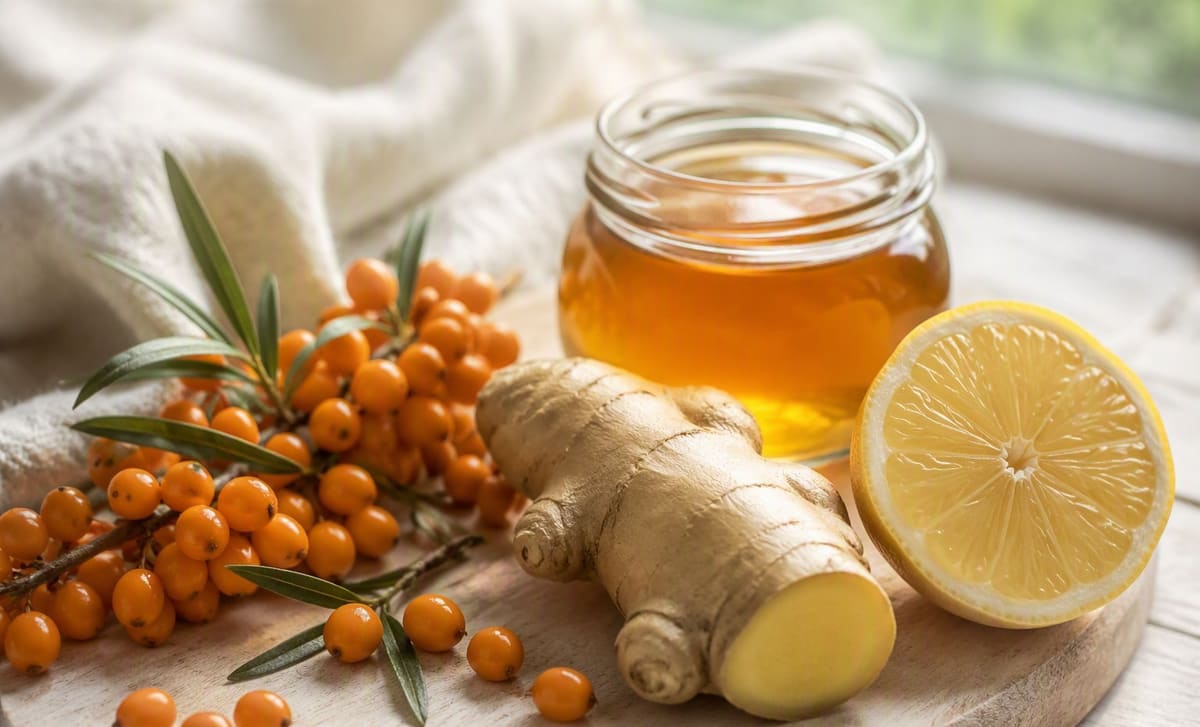
The biology case for sea buckthorn and immunity rests on three legs: high vitamin C, flavonoids that behave interestingly in lab models, and centuries of traditional use. All three are real. None is a human immune-outcome trial, and the one such trial found no fewer infections. This page is the biology. The verdict lives on the immunity page, and the immunity cluster grades every related claim in one place.
Vitamin C: the solid, unglamorous leg
Fresh sea buckthorn berries carry roughly 200 to 600 mg of vitamin C per 100 grams depending on species and origin, several times an orange by weight. Vitamin C contributes to normal immune function. That is settled nutrition, and it applies to vitamin C from berries exactly as it does to vitamin C from any food.
Two honest limits. First, “supports normal function” is not “prevents illness”. Second, processing matters: dried powders and juices lose some of the fresh-berry advantage. The nutrition hub covers the ranges in detail.
Flavonoids: the lab leg
Sea buckthorn contains quercetin, kaempferol, and isorhamnetin glycosides, flavonoids that show immune-related activity in cell and animal models. Interesting is the right word for this. Lab models isolate mechanisms, and mechanisms regularly fail to become effects in people. Treat this leg as a reason researchers keep looking, not a reason to buy.
Tradition: the human-history leg
Tibetan and Mongolian medicine used sea buckthorn for centuries, including for resilience through harsh seasons. Tradition is evidence of long safe use and cultural value. It is not a controlled trial, and on this site it never wears the costume of one.
The one human immune-outcome trial
About 250 healthy adults ate 28 grams of sea buckthorn berry puree or a placebo daily for three months. Infections and colds: no difference. The inflammation marker CRP: decreased in the berry group. That pair of results is the entire human trial record for sea buckthorn and immune outcomes, and the colds page walks through it in full. The inflammation page takes the CRP thread.
The practical reading
Eat the berries or drink the juice because you enjoy them and value the vitamin C, the same logic as any nutrient-dense fruit. Do not buy them as an immune shield, because the one experiment that tested that idea came back negative. If you take concentrated oil supplements, the safety hub covers who should check with a doctor first.
What “supports normal immune function” means
The phrase on supplement labels has a precise, deflated meaning. Certain nutrients, vitamin C among them, are required for immune cells to develop and do their jobs, and deficiency genuinely impairs immunity. Correct a deficiency and function returns toward normal. That is the entire claim. It says nothing about extra benefit in people who are not deficient, and most adults eating a reasonable diet are not deficient. More of a sufficient nutrient does not make immunity supernormal, in the same way adding gas to a full tank does not make the car faster.
The processing problem
The 200 to 600 mg per 100 grams figure belongs to fresh berries, and fresh berries are what almost nobody eats. Heat, drying, and storage each take a cut of vitamin C, so juice, dried berries, and powders deliver less than the fresh-fruit headline. The vitamin C page tracks what survives each process. The honest move is to count the form you actually take, not the form in the marketing photo, and you can compare the forms side by side on cost and what each one keeps.
The flavonoid file, kept honest
Quercetin, kaempferol, and isorhamnetin glycosides show immune-related effects in cell and animal models: altered signaling, moderated responses, interesting chemistry. The flavonoids page catalogs what the berries carry. The repeated lesson of nutrition science is that cell models over-promise, because a dish has no digestion, no metabolism, and no placebo group. These compounds are why researchers keep sea buckthorn on the study list. They are not a reason to expect fewer colds.
Weighing the three legs together
Stack the legs honestly and the picture resolves. Vitamin C: real nutrition with a precise, limited claim. Flavonoids: real molecules with lab-grade evidence. Tradition: real history with no control group. One human immune-outcome trial sits on the other side of the scale, and it found no fewer infections. That is why this site grades the immune claim as nutrition rather than protection.
The immune system does not want boosting
One last reframe worth keeping. A healthy immune system is a balanced one, and the conditions medicine struggles with are often overactive immunity: allergies, autoimmune disease, chronic inflammation. A substance that genuinely boosted immunity without limit would be a hazard, not a tonic. Nutrition supports the system you have. That modest sentence is the whole honest claim.
The deficiency exception
The one group where vitamin C genuinely changes immune outcomes is people running low: poor diets, heavy smokers, some elderly people. If that might be you, the fix is diet-wide, and any fruit helps.
Frequently asked questions
How does sea buckthorn affect the immune system?
Through nutrition, mostly. The berries carry high vitamin C, which supports normal immune function like vitamin C from any food, plus flavonoids that show immune-related activity in lab models. In humans, the one controlled trial found no fewer infections, only a lower inflammation marker. Biology says plausible, trials say unproven.
Does processing change sea buckthorn's vitamin C?
Yes. The 200 to 600 mg per 100 grams figure belongs to fresh berries. Heat, drying, juicing, and storage each take a cut, so juices, dried berries, and powders deliver less than the fresh-fruit headline. Count the form you actually take, and the nutrition pages track what each process keeps.